
Technical article
Planetary Ball Mill Purity: It's the Jar and the Balls
Repeatability and purity problems in planetary ball milling usually trace back to jar and ball wear, not to the speed and time settings.
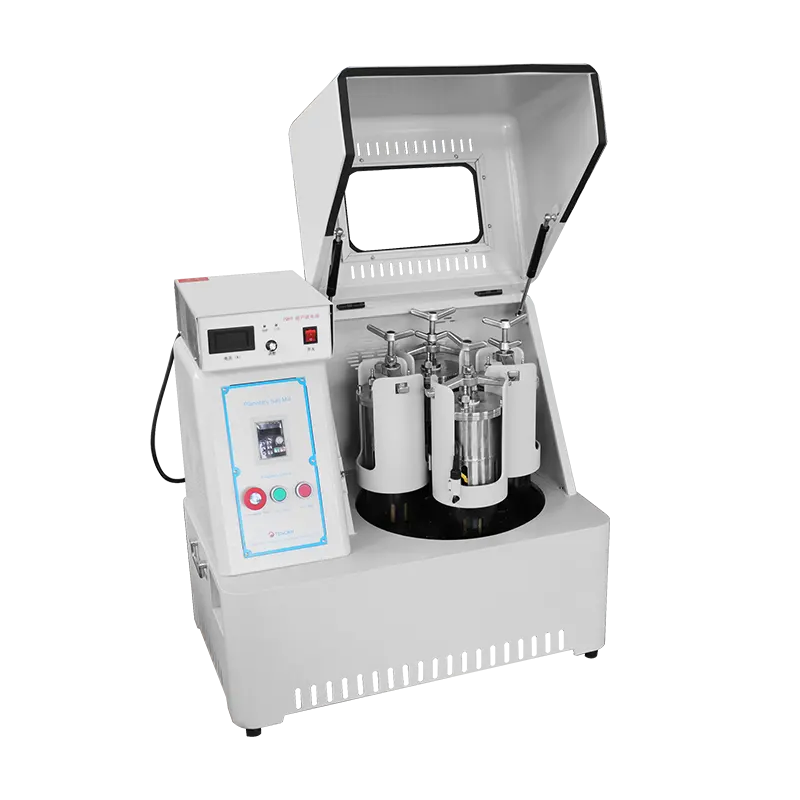
You Have Already Tried Everything the Manual Suggests
You run the same powder, the same jar, the same batch of balls and the same recipe you used last month. Three repeats, three different particle size distributions. The coarse tail never quite closes, no matter how long you mill. The ICP results come back with iron, zirconium or aluminium a few tens of ppm above the certificate of analysis, and nobody in the lab can say where it entered the process. The first batch after a jar change looks perfect; the third one does not.
So you do what the manual, the application note and the senior colleague all recommend:
- You run a speed ladder — low, medium, high — looking for the setting where the tail finally closes.
- You extend the milling time, then extend it again, and watch the median size fall while the impurity line climbs.
- You change the ball-to-powder ratio, then change it back, because the new ratio mills faster but reads dirtier.
- You add a cleaning step: solvent rinse, ultrasonic bath, wipe, dry, rinse again, then a blank run you convince yourself is close enough.
Each of these moves the numbers a little. None of them makes the result reproducible, because none of them touches the part of the system that is actually changing from batch to batch.
The Variable You Have Not Changed Sits Inside the Jar
Planetary ball milling is a high-energy impact process by design. The jar is carried around the sun wheel while spinning about its own axis, so the media is repeatedly lifted and thrown across the interior, striking the wall and each other at high relative velocity. That is what makes the technique fast. It is also what guarantees that a fraction of the energy you put in never reaches the powder: it goes into the jar wall and into the media surface, and it removes material from both.
You cannot eliminate that. What you can control is where the wear products end up, where the powder hides, and whether your sample is large enough to absorb the contamination without noticing. Those three questions explain almost every unexplained purity and repeatability failure in a planetary ball mill, and none of them is answered by a speed or time setting.
The scale effect deserves its own paragraph, because it is the one most often missed. In a five-gram batch, one milligram of abraded jar material is two hundred parts per million. In a five-hundred-gram batch it is two parts per million, below most people's concern threshold. The same jar, the same media and the same recipe can be perfectly acceptable on the pilot line and unacceptable in a gram-scale experiment, which is why contamination complaints cluster around research batches and seem to vanish during validation.
Defect One: Jar and Media Wear as a Contamination Pathway
The mechanism
Wear rate is set by the material pair, not by the recipe. When the powder is harder than, or comparable in hardness to, the jar wall — calcined alumina, zirconia, silicon carbide, tungsten carbide, many cathode and anode materials — the particles behave like a lapping compound. They are pressed against the wall by the media and abrade it continuously. A stainless steel jar used for an iron-sensitive material is the clearest case: the mill does exactly what it was bought to do, and adds iron to every batch while doing it.
The media sit on the same side of the ledger. Density determines the energy carried into each collision; diameter determines how that energy is concentrated. Oversized balls focus the stress into a small contact patch and score the wall. Undersized or low-density balls deliver less energy per impact, so the operator compensates with longer times or higher speeds, which raises the total number of wall-loading cycles and the total amount of wear. Either way, the jar is asked to absorb energy it was never selected for.
Corrosion runs quietly alongside abrasion. Moisture, acidic or alkaline slurries and certain solvents attack the binder phase of cemented carbides and the surface of some ceramics, loosening grains that then appear in the powder as discrete fragments rather than dissolved ions.
What it does to your data
The signature is unmistakable once you know to look for it. Impurity concentrations rise with cumulative milling energy rather than with any single parameter, so the same nominal recipe gives different results on different days if the number of passes or the jar history differs. The particle size distribution develops a coarse tail that will not mill out, because hard wear debris behaves differently from your sample under the same stress field. Colour, tap density and sintering behaviour shift between batches. In XRD an amorphous halo or an unassigned minor phase appears. In trace analysis, the contaminant elements match the jar and media composition almost embarrassingly well.
Why process adjustment cannot fix it
Speed and time control how much energy is delivered. They do not change wear per unit of delivered energy, which is a property of the material pair and the surface condition. Shorten the run to reduce contamination and you under-mill the powder, so the tail returns. Lengthen it to close the tail and the impurity line climbs. You are trading one failure mode for the other along a curve with no acceptable minimum, because the fixed term in the equation is the jar and the balls.
Defect Two: Structural Residue, Carry-Over and the Illusion of Cleaning
Where the powder actually hides
Look inside a jar that has been in service for a year, under oblique light. You will find circumferential scratches from earlier runs, a weld line or a step where the wall meets the floor, a radius the media cannot reach, a lid thread, and a seal groove holding a fine ring of powder no matter how often it is rinsed. On unpolished sintered ceramics you will also find open porosity that has been loading itself with sample since the day it was bought.
Every one of those features is a reservoir. Some release material into the next batch gradually; some discharge all at once when the groove finally sheds its contents into a batch of a different composition.
How it distorts the experiment
A gram of last week's sample carried into this week's five-gram batch is twenty percent of the total. That is not a trace effect; it is a reformulation. It shows up as a shoulder on the particle size distribution that cannot be milled away, a phase in XRD that should not exist, an element an order of magnitude off in ICP, and — most frustratingly — a first run after a jar change that looks flawless and a third run that does not.
Why longer cleaning does not solve it
Solvent reaches surfaces. It does not reach the bottom of a scratch twenty micrometres deep, and an ultrasonic bath removes loose particles, not particles mechanically keyed into a groove. Worse, the cleaning itself is a wear process: brushing, scraping and repeated handling add fresh scratches, and every new scratch enlarges the volume available to trap powder. A jar cleaned aggressively enough to feel safe becomes a jar that contaminates faster. The only durable fix is a geometry and a surface finish with fewer places to hide.
Design the Machine, the Jar and the Media as One System
Once the failure is located in the components, the purchasing question changes. You are no longer buying a mill and then fitting jars to it. You are specifying a combination — machine, jar material, interior finish, media density and diameter — matched to your powder, your sample mass and your analytical detection limits. Each specification below answers a specific failure described above.
| What you observe | What it points to | What to specify |
|---|---|---|
| Impurity elements match the jar or media | Abrasive or corrosive wear of the material pair | Jar and media composition matched to powder hardness and analyte list |
| First batch after a jar change is clean, later batches drift | Residue accumulating in scratches, seams and grooves | Polished interior, radiused geometry, replaceable liner |
| Tail will not mill out, shape changes between runs | Over- or undersized media, wall scoring | Media density and diameter derived from jar volume and target fineness |
| Gram-scale batches fail, kilogram batches pass | Contamination mass relative to sample mass | Lower-wear material pair plus fewer impact hours per batch |
Match the jar and media to the powder, not to the shelf
Choose a jar material significantly harder than the powder where abrasive wear dominates. Avoid steel entirely for iron-sensitive chemistries. For trace-element work, pick a jar whose elements are either outside your analyte list or can be tolerated at your reporting level. Zirconia is a workhorse but brings zirconium and yttrium; agate is clean but soft and porous; corundum is hard but alumina-bearing; tungsten carbide is hard and dense but brings cobalt and tungsten. There is no universally cleanest jar — only the one whose contamination you can tolerate and whose hardness you need.
Specify media density and diameter as a set
Density sets impact energy; diameter sets the number of contact points and the stress at each one. Both should be derived from the jar volume and the target fineness, not inherited from the last project. If the required energy can only be reached with a ball size that scores the wall, that is a signal to change density rather than to accept the scoring.
Demand a cleanable interior
Polished interior surfaces, radiused transitions instead of steps, no dead zone the media cannot sweep, minimal seams, and a lid and groove designed to be inspected rather than merely rinsed. Where a liner is used, it should be replaceable, so the jar is retired when its surface is worn instead of when it becomes a contamination source.
Treat the seal as a wear part
The sealing element is the softest material in the assembly and the first to degrade. Solvent compatibility, replacement interval and groove cleanability belong in the specification, not in the maintenance afterthought.
Where Ultrasonic Assistance Fits
Adding ultrasonic energy to the milling cycle changes the wear arithmetic rather than escaping it. In an ultrasonic planetary ball mill, ultrasound acts on the slurry during processing and helps break down the agglomerates that high-energy impact tends to re-form. Fewer hours of ball impact for a given target fineness means less cumulative wall loading — precisely the term you could not fix by adjusting speed or time. It does not replace correct jar and media selection; it reduces the mechanical work the jar has to absorb while doing its job.
What Changes When the System Is Right
Batches repeat: the same powder, milled in the same jar-and-media combination, gives the same distribution and the same impurity profile within analytical error, so the third run looks like the first. Data survives review: when a reviewer asks about contamination, you answer with a material pair and a measured blank instead of a cleaning protocol. Expensive powder stops disappearing: the fraction lost to wall adhesion and embedded residue becomes small and known, which matters when the sample costs more per gram than the mill. Scale-up has a basis: moving from a small jar to a larger one becomes a defined change in jar volume, ball diameter and ball count rather than a fresh round of trial and error, and you know exactly which variable you changed.
Before Your Next Run, Ask Three Questions
- What is the hardness of my powder relative to my jar wall, and what does that jar contribute to the elements I report?
- What does the interior of my jar look like under oblique light — and when did I last inspect it instead of cleaning it?
- When I changed jar size or jar type, did I re-derive the media specification or simply carry the old recipe across?
If you cannot answer the first question with a material name and a hardness number, the next variable to change is not the speed. Send the powder type, the target fineness, the sample mass per batch and the analyte list you report, and the jar material, media density and diameter, interior finish and machine configuration can be worked out together — before the next batch goes into the jar.