
Technical article
Your Planetary Ball Mill Problem Is in the Jar, Not the RPM
Dirty samples, trailing distributions, and poor repeatability trace to jar and ball choice, not RPM or time.
The Failure Loop You Already Know
If you run a planetary ball mill, you know the loop. The same rotation speed, milling time, ball-to-powder ratio, and pause interval produce a clean first batch, a slightly darker second batch, and a third batch with a tail in the particle-size distribution and unexpected iron, zirconium, or aluminum in elemental analysis. You tighten the lid, clean the jar, and run it again. The numbers move, but they do not settle.
You try the usual fixes:
- Recheck the rotation speed and milling time, then repeat the run.
- Raise the ball-to-powder ratio to push the grind harder.
- Extend the cleaning cycle with more solvent and more wiping.
- Change the operator or the order of loading, hoping the result stabilizes.
Each action is reasonable. Together they share one assumption: that the mill is a black box and the recipe is the only variable worth changing. In a high-energy planetary mill, that assumption fails. The jar and the grinding balls are not a passive container and a set of inert tools. They are the surfaces where the energy is transferred, where wear is generated, and where residue is stored.
The Variable Hiding in Plain Sight: The Jar and the Ball
Planetary ball milling is a high-energy impact process, not a gentle blend. The jar rotates around its own axis while the sun wheel turns in the opposite direction. The media charge is thrown against the wall, lifted, and released. Every impact fractures powder, and every impact also loads the jar wall and the balls. Wear is not a sign that the mill is broken. It is a consequence of using high energy to make fine particles.
The useful question is not whether wear occurs. It is where the wear goes, how much of it stays in the jar, and whether your sample mass can tolerate it. Suppose a 5 g sample loses 5 mg of jar wall into the powder. That is 1,000 ppm before you subtract an analytical blank. At 10 mg, it is 2,000 ppm. A wear rate that would be invisible on a production line becomes a dominant part of a gram-scale experiment. This is why a sample can look darker, sinter differently, or fail a purity specification even when the recipe has not changed.
The jar and the ball are not interchangeable accessories. They are the boundary between your powder and the mill. Material choice, wall finish, joint geometry, and seal design decide whether wear becomes contamination or stays out of the sample. They also decide whether the powder that leaves the jar is the same powder you loaded.
A parameter sweep assumes a stable boundary. When the boundary is unstable, changing speed or time measures the jar's wear behavior as much as the powder's response. You may find a condition that works once, but you have not found a condition you can defend.
Defect One: Wear Debris That Reports to the Sample
The mechanism: hardness mismatch under repeated impact
Wear debris enters the sample when the jar or media is softer than the powder, or when the contact conditions are severe enough to damage even a hard surface. A hard ceramic powder can scratch a softer jar wall. A dense media charge can polish or pit the balls. A chemically resistant jar can still be a poor tribological match, because chemical resistance does not describe how a surface behaves under repeated impact and sliding.
The debris does not need to be visible. It can be fine enough to remain suspended in the powder. It can also oxidize, hydrate, or react during milling, so the contaminant you detect may not be the same phase that left the wall.
What you see in the data
Elemental analysis may flag iron, chromium, or nickel from steel wear; zirconium or yttrium from zirconia wear; or aluminum from alumina wear. The signal may be intermittent because wear depends on load, jar history, and the batch. Color can shift. A phase that should not be there can appear. Sintering behavior can change because a small fraction of hard debris alters packing and grain growth.
Particle-size data can develop a tail that looks like poor milling. The analyzer cannot tell a 2 micrometer wear particle from a 2 micrometer sample particle. If the tail appears only in some batches, or if it survives a change in milling time, suspect the hardware before you add another pass.
Why process adjustment cannot fix it
Lowering the rotation speed reduces impact energy, but it does not remove the contact that generates wear. Extending the milling time adds more collisions. Raising the ball-to-powder ratio adds more media surface and more opportunities for jar and ball loss. Cleaning removes loose residue, but it does not stop the next run from producing new debris. You are trying to tune a process around a surface that is actively changing the sample.
Defect Two: Surface Memory in the Jar
The mechanism: scratches, seams, and seal grooves
In a planetary mill, centrifugal force presses powder against the jar wall. Fine particles are the most mobile and the most likely to adhere. A scratch, a weld seam, a sharp corner, or a seal groove gives them a place to sit. The layer may be thin, but it is not necessarily removed by a normal wash. A jar can look clean and still fail a blank run.
Surface memory is a batch-history problem. The jar that held a doped sample yesterday can release a trace of it today. The jar that was cleaned with an abrasive can carry new scratches into the next campaign. The seal groove is especially difficult because it is a recess with limited flow, and because the seal itself may absorb solvent or powder.
What you see in the data
The first batch after cleaning may be acceptable, while the next one drifts. A contamination episode may appear after a jar change or after a maintenance step. Particle-size tails can come and go with the jar, not with the recipe. If you run inert-atmosphere jars, add a seal-specific path: an aged or abraded O-ring can leak, take up oxygen or moisture, or shed seal fragments into the powder. The result can be an oxide phase, a failed atmosphere, or a contaminant that no amount of dry-time will remove.
Why more cleaning does not solve it
Solvent reaches open surfaces. It does not reliably reach the bottom of a scratch or the back of a seal groove. More aggressive cleaning can create new scratches, which create new reservoirs. If the seal is worn, cleaning may push particles deeper instead of removing them. A cleaning log proves that a procedure was followed. It does not prove that the surface is clean.
The Fix Is Not a Better Recipe. It Is a Co-Selected System
The answer is not a secret speed setting. It is a host, jar, and ball system selected together for the powder, the sample mass, and the data you need. Each choice should answer a failure mode you have already seen.
Match jar and media material to the powder, not to a catalog tier
Start with hardness and chemistry. An iron-sensitive powder should not be milled in an iron-bearing jar just because that jar is durable. A high-hardness powder can wear a soft jar even if the jar is chemically inert. The jar and the media should be considered as a pair, because a hard ball in a soft jar can concentrate wear on the wall. The goal is a material pair that survives the energy dose without donating an unacceptable amount of mass to the sample.
Choose media density and diameter for useful energy, not maximum wear
Media density, ball diameter, and ball count set the impact energy and the wear surface. Larger, denser balls deliver more energy per impact, but they also load the jar. A mix of diameters can improve packing, but every additional size adds contact area. The practical question is whether the media delivers enough energy to the powder bed with the shortest reasonable run. If you need the smallest balls and the longest time to reach fineness, you may be trading a particle-size problem for a contamination problem.
Specify wall finish and geometry as process parameters
Ask for a smooth, polished interior, radiused transitions, and as few blind recesses as possible. The seal should sit out of the main powder path. If you cannot inspect and dry a groove, it is a residue trap. A removable or replaceable seal is easier to manage than a seal that is bonded into a crevice. These details belong in the specification, not in a cleaning procedure written after the first bad batch.
Treat the seal as a material and a wear part
For inert-atmosphere jars, the seal is part of the atmosphere boundary. It must be compatible with the solvent, the temperature, and the cleaning routine. A seal that swells, hardens, or abrades will leak or shed. Keep seal age in the batch record and replace the seal on a schedule rather than waiting for a failed run.
Integrate host, jar, and ball at the selection stage
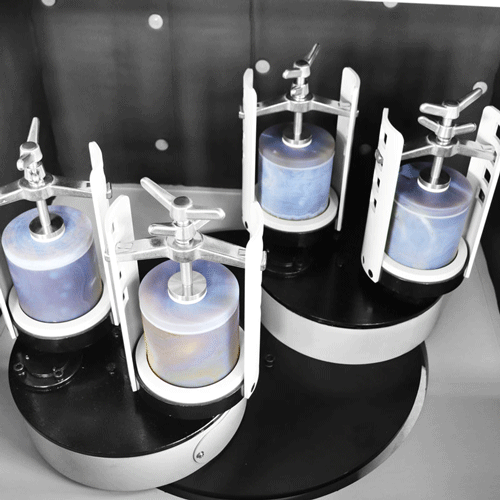
A platform such as the Dual Planetary Ball Mill is relevant only when the jar fit, the jar geometry, and the media load are treated as one system. The host sets the motion. The jar sets the wear boundary. The media sets the impact spectrum. If one of those is chosen in isolation, the other two will expose the mismatch.
Use the same logic when you compare jar options. Do not ask only which jar lasts longest. Ask which jar keeps the sample clean at your energy dose, and which media can deliver that dose without adding wear. A longer-lasting jar that contaminates the sample is not a lower-cost choice.
A Practical Diagnostic Sequence for Your Next Batch
You do not need a full method redevelopment to find the hardware contribution. Run a short, controlled diagnosis before the next parameter sweep.
- Run a blank with the same jar, media, and program. Use a representative carrier or a small amount of the same powder, and analyze the elements you care about. A blank that is not clean tells you the jar is contributing.
- Inspect the jar under oblique light. Look for scratches, pitting, seams, and polish loss. Check the seal groove with a soft tool and a drying step. If the groove cannot be cleaned and dried, treat it as a design defect.
- Weigh the jar and media before and after a run. A measurable loss on the order of your analyte is a warning. You do not need a precise wear model to see that the hardware is moving mass into the sample.
- Change one hardware variable at a time. Keep the program fixed and change the jar material, the media material, or the seal. If the tail or the contamination follows the hardware, you have found the cause.
- Record jar identity, seal age, and cleaning method in the batch record. Batch repeatability depends on knowing which surface was used, not only which recipe was entered.
This sequence will not make a bad jar good. It will show you whether the jar and media are part of the problem, so you can stop tuning around them.
What Changes When the Jar and Ball Stop Being Invisible
When the jar and media are selected for the powder, the data become easier to defend. Batch-to-batch variation drops because the wear boundary is stable. Cleaning becomes a verification step rather than a guess. Particle-size distributions lose the tail that came from debris, not from the powder. Elemental flags can be traced to a source instead of being blamed on the recipe.
For a research group, that means results that can survive review. For a process engineer, it means a scale-up basis: if the jar material, media density, and wall condition are specified, a change in batch size or jar format can be evaluated against known variables. If they are not specified, every scale-up failure is ambiguous. You cannot tell whether the process changed or the hardware matched less well.
For an expensive or high-purity powder, the value is direct. Material that stays in the jar as residue or leaves as wear debris is material you cannot sell, test, or publish. A co-selected system protects the sample and protects the batch record.
Before you run another design of experiments, ask for a jar and media audit. Bring the powder, the target particle size, the current jar and balls, and one failed batch record. Ask which wear path is most likely, which surface is holding residue, and which material pair would remove that path. A supplier who can answer at the level of the jar, the ball, and the seal is more useful than a catalog with a longer list of sizes.
The next time a batch fails, do not begin with the RPM. Look at the surfaces that touched the powder. The jar and the ball are where the repeatability, the purity, and the scale-up answer usually are.