
Technical article
Why Planetary Ball Mill Results Drift: Jar and Ball Wear
Drifting particle size and cross-contamination in planetary ball milling start with the jar, not the process recipe.
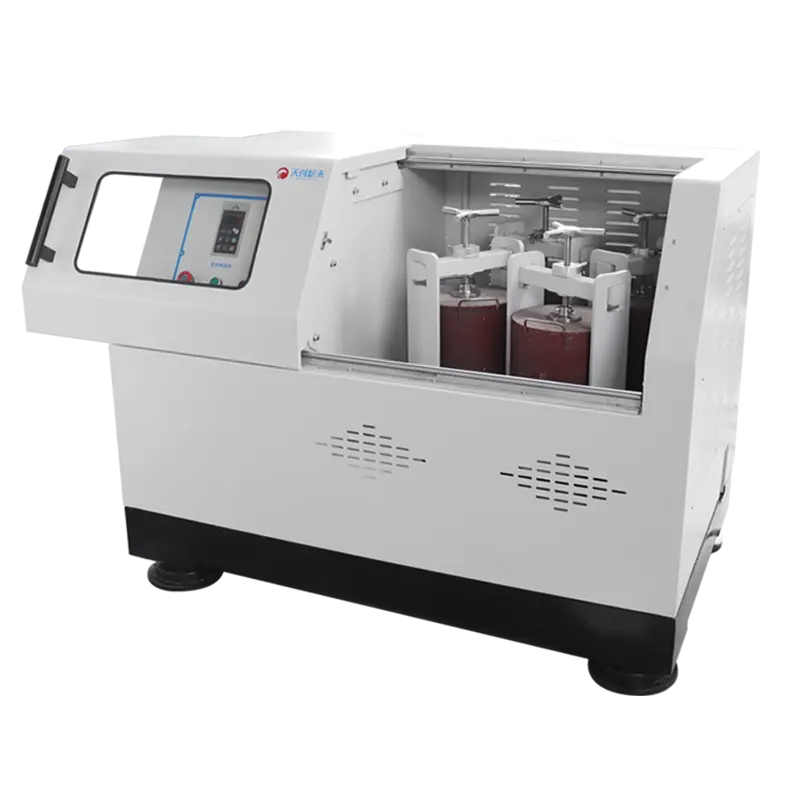
You ran the same recipe three times this week. Same jar, same grinding balls, same rotation speed, same milling time, same ball-to-powder ratio, same operator. Run one hit your target particle size. Run two came back with a coarse tail that would not refine no matter how you repeated the measurement. Run three went to elemental analysis and came back with iron at several times the level of the batch you ran last month, on the same powder, from the same bottle.
So you did what any careful researcher does. You changed something.
- You extended the milling time, because finer is usually better.
- You raised the rotation speed, because more energy means a smaller median.
- You adjusted the ball-to-powder ratio, because that is the lever everyone cites.
- You lengthened the cleaning procedure, because the jar must have been dirty.
None of it held. The next three runs scattered again, and the scatter moved: this time the tail was gone, the iron was back, and the median had drifted in the other direction. That pattern — a parameter that works once and then stops working — is the signature of a variable you are not writing down. In planetary ball milling, that variable is almost never the number on the dial.
The Failure Loop Has a Blind Spot
Every item on that list rests on the same assumption: that the mill is the variable and the hardware is the constant. In a low-energy process that is roughly true. In a planetary ball mill it is not. The jar is not a passive container that happens to sit in the machine; it is the surface against which every collision is delivered, and it is being consumed while you work.
High-energy impact always removes material from somewhere
A planetary ball mill mounts the jar on a sun wheel that turns one way while the jar spins the other. Balls are lifted, thrown across the jar, driven into the wall, then dragged and rolled along it before the next impact. Energy enters the powder through ball-to-ball and ball-to-wall collisions, and the wall takes the same hits the powder does. Abrasion at that interface is governed by the hardness difference between media and powder, the impact angle, and the condition of the wall surface.
The honest conclusion is uncomfortable: some material loss from jar and media is not an accident, it is the cost of the energy you are buying. The engineering question is not whether the jar sheds, but where the shed material goes, and how much of it a given sample can absorb before your result stops describing your powder and starts describing your hardware.
Why a gram-scale sample feels it and a production batch does not
Consider the arithmetic. If jar and balls together lose three milligrams across a run and your charge is three grams, you have added roughly 0.1 wt% of foreign material to the sample. The same three milligrams lost in a three-kilogram batch is about one part per million — invisible in a certificate of analysis. This is the part of planetary ball milling that does not scale down gracefully: the smaller the charge, the larger the fraction of it that is jar.
That is why a method that was clean at large volume can be visibly contaminated at small volume, and why a protocol transferred from a production line into a research jar can fail for reasons that have nothing to do with the protocol. In a few-gram batch, wear debris is not a trace footnote. It is a component of your composition.
Defect One: The Jar and Media Are a Contamination Source
Hardness mismatch, not operator error
Jar materials sit on a spectrum that trades hardness, density, chemical inertness and cost against one another. Agate is chemically clean and low in metallic contamination, but it is soft and wears quickly against hard powders. Zirconia is dense and tough and survives high-energy impact, but it contributes zirconium and yttrium. Alumina is hard and inexpensive, and it is also an aluminium source in a sample where aluminium is an analyte. Tungsten carbide is extremely hard and heavy, and it brings tungsten and cobalt with it. Stainless steel is convenient, easy to machine and easy to seal, and it is an iron, chromium and nickel reservoir.
Any of these can be the right answer. None of them is the right answer for every powder. When the jar is softer than the powder, or when the powder is chemically aggressive toward the lining, the wall becomes a consumable that reports directly into your product.
How it shows up in the data
- Elemental analysis drifts first. Iron, chromium, zirconium, aluminium or yttrium appear above the baseline you established on the same powder lot, and the level rises with milling energy and time.
- Phase analysis catches what the assay misses: an extra reflection, an amorphous halo, a lattice parameter that no heat treatment explains.
- Physical symptoms follow — a colour shift in a white powder, a magnetic response in a non-magnetic material, a sintering temperature that moves batch to batch.
Why the parameter fix cannot reach it
Lowering the rotation speed does reduce wear, and it also reduces the energy delivered to the powder, so you miss the size target in order to win a contamination argument you should not have had to have. Extending time does the opposite: total wear grows with the duration of contact. Changing the ball-to-powder ratio redistributes energy between collisions, not the hardness pair at the wall. Contamination per gram of product is fixed by the materials choice, and no combination of speed, time and ratio edits a materials choice.
Defect Two: Residue Lives in Scratches, Seams and Grooves
Where the powder actually hides
Look inside a jar that has run for a year, under oblique light, and you will read a history. A polished ring where the ball charge ran. A dull band where it stalled. Machining marks across the bottom radius. A step where the wall meets the base, a thread that sits inside the powder zone, a groove that holds the lid gasket, and a crevice between lid and body that is exactly the width of a fine powder.
Under high-energy impact those features stop being cosmetic. A ductile jar — stainless, nylon, toughened polymer — deforms locally and raises a lip around each peened spot. A brittle jar — agate, alumina, zirconia — chips at edges and at the radius where stress concentrates. Either way, a scratch becomes a trap: powder is compacted into it by one impact and is not re-entrained by the next.
How it shows up in the data
Three distinct symptoms, usually misdiagnosed as three different process problems:
- Carryover. Residue from the previous batch in a small charge is a real fraction of the new sample, and it carries the previous sample's chemistry, not yours.
- Coarse tailing. Compacted material in a scratch or groove is not milled at the same rate as loose powder; it releases late, as flakes and agglomerates, and lands on the coarse side of the distribution as a tail that will not refine.
- Lost repeatability. Retained mass varies run to run, so the effective charge varies, so the effective ball-to-powder ratio varies. Your identical runs were never identical — the jar was quietly changing the ratio for you.
That last point is the one worth sitting with. The reason one recipe gives three different answers is often not that the mill is unstable. It is that the jar carried a different amount of yesterday's powder into today's run, and the ratio in your notebook is not the ratio the powder experienced.
Why cleaning longer does not solve it
Solvent reaches the open surface. It does not reach the bottom of a scratch a few tens of micrometres deep, the underside of a compressed gasket, or the dead volume behind a thread. Adding cleaning cycles adds time and solvent without adding access. Worse, aggressive cleaning — acid washes, abrasive pads, prolonged cavitation on a damaged surface — enlarges the defect it is meant to remove, so the trap gets bigger with every attempt to empty it. The defect is geometric. Cleaning is a surface action, and geometry beats surface action every time.
Defect Three, Only If You Mill Under Inert Gas: The Gasket Is a Wear Part
If the process runs under argon or nitrogen, one more component joins the wear chain. The lid gasket is a compressed elastomer doing two jobs at once: keeping the inert atmosphere in and the laboratory atmosphere out. Both degrade with use. Solvent attack, repeated compression and the temperature swing of a high-energy run harden the material and give it a permanent set, so the seal that was tight on run one is marginal by run fifty. A slow leak does not announce itself; it appears as an oxide phase in a powder that was supposed to be oxygen-free, or as scatter that only shows up on longer runs.
There is a second failure mode that is easier to miss. An ageing gasket abrades. Polymer fragments drop into the jar and become part of the sample — organic contamination in a carbon-sensitive analysis, or a dark speck in a white powder that no amount of sieving removes. The gasket is not a permanent part of the jar. It is a consumable that deserves a replacement interval and a material selected against your solvent, not whatever was fitted when the jar was purchased.
The Fix Is a System: Mill, Jar and Media Chosen Together
Once the failure is located in materials and geometry, the remedy stops being a setting and becomes a selection. Three components have to agree with each other and with the powder: the jar, the media, and the machine that drives them.
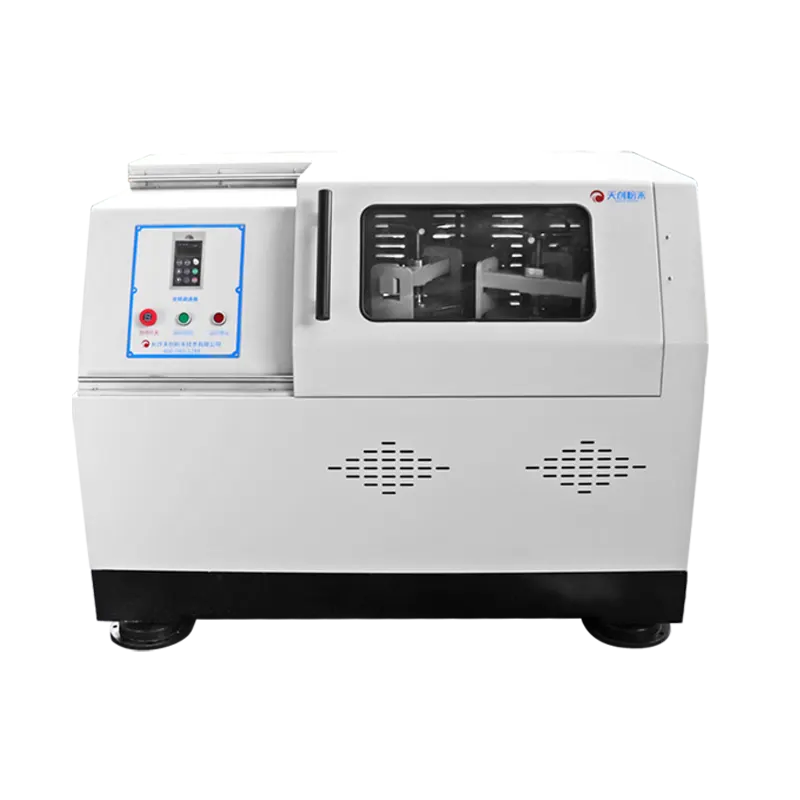
Jar material matched to powder hardness and analyte list
Two rules cover most cases. First, the jar should be at least as hard as the powder, so the wall is not the softer body in the collision. Second, no element of the jar should appear on your analyte list — if aluminium is being quantified, an alumina jar is a conflict of interest, and if iron is the measurement, stainless is the wrong default no matter how convenient it is. Write the jar material into the method section before the first run, not after the first failed one.
Media: material, density and ball size distribution
Impact energy scales with the mass of the ball, so density is a process variable, not a shopping preference. Moving to denser media delivers more energy per collision, which is why it cannot be treated as a free substitute for a higher speed setting — you are changing what hits the wall as well as what hits the powder. Keep jar and media in the same material family so that any wear that does occur adds one known element instead of three unknown ones. Ball size distribution matters too: a narrow single-size charge produces a narrow collision spectrum, while an excess of large balls gives fewer, deeper contacts and coarser damage.
Interior finish and cleanable geometry
A polish is not decoration. Surface roughness is, quite literally, the size of the particle trap, and a mirror finish with radiused internal corners and no exposed thread in the powder zone has far fewer places to hide a batch. A lid design that keeps the gasket out of the powder contact area removes an entire contamination path. These are structural decisions, and they are the reason two jars of the same nominal material can behave completely differently in the same machine.
Gasket material, treated as a consumable
For inert-atmosphere jars, select the seal against the solvents you actually use and the temperatures you actually reach, then put it on a replacement schedule. A gasket is cheap compared with a ruined batch of oxygen-sensitive powder, and far cheaper than an experiment you cannot reproduce.
Scaling the recipe without changing the answer
When a validated recipe has to leave the gram scale, the jar-and-media pairing has to travel with it. The Vertical production planetary ball mill is the production-scale planetary platform in this line, and the questions to ask about it are the same ones you asked about your research jar: which material, which surface, which seal, and which media. Answering them once, as a set, is what makes a scale-up a controlled change rather than a fresh development project.
What Changes When the Jar Stops Being the Unknown
- Repeatability becomes ordinary. The third run matches the first because retained mass is near zero and the wall is no longer a variable.
- Data becomes publishable. You can state jar and media material in the method section without a contamination footnote, and a reviewer will not ask what the iron peak was.
- Expensive powder stays in the sample. In a small batch of a costly material, the fraction that stays in a scratch is your material, not waste.
- Scale-up gets a basis. When jar and media are specified as a set, changing jar size is a controlled change with a known failure mode, which is exactly what a process engineer needs to defend a decision.
A Five-Minute Check Before Your Next Run
- Read the elemental analysis of the last failed batch. Is the contaminant an element that exists in your jar or media? If yes, stop tuning the speed.
- Inspect the jar wall under oblique light and look for the polished ball track, the scratch band and the ring at the radius.
- Run a blank: mill the same jar and media with no powder, then measure what came off.
- Weigh jar and media before and after a run. Mass loss per hour is your wear rate, and it belongs in the notebook next to the speed.
- Filter the solvent from your normal cleaning procedure and look at what it caught. If the answer is nothing, the residue is still in the jar.
Pick the Jar Before You Pick the Next Number
If a batch has already cost you a week, the useful next question is not which speed to try next. It is which jar, which media and which jar geometry this powder was supposed to run in — and what the wear products of that combination do to your analyte list. Send us the powder's hardness, the elements you quantify, your target particle size and whether the run needs an inert atmosphere, and we will come back with a jar-and-media combination plus the specific failure mode it removes. That is a shorter conversation than another month of parameter sweeps, and it ends with a method you can defend.