
Technical article
Planetary Ball Mill Results Drift: Blame the Jar and Balls
When ball mill results drift, the jar and grinding balls may be the real variables.
The Failure Loop You Already Know
You set the same rotation speed, milling time, and ball-to-powder ratio you used last week. The first run looks acceptable. The second run shows a particle-size tail that will not fit your histogram. The third run comes back with iron, zirconium, or aluminum signals that were not in the starting powder, and the batch-to-batch difference is large enough to make you question the method. You do what any careful researcher does: you adjust.
You lower the speed. You extend the time. You change the ball charge. You clean the jar for twice as long, then run a solvent blank. The next batch is still inconsistent. The numbers move, but the problem does not disappear. The uncomfortable possibility is that the variables you keep changing are not the variables that are failing.
Four fixes feel productive and often change the result just enough to mislead you:
- Re-running the same recipe at a different speed
- Adding time to mill it finer
- Changing the ball-to-powder ratio without changing the media
- Cleaning harder, longer, or with a different solvent
None of these fixes addresses the wear surface. None of them removes a scratch, closes a seam, or changes the material that is rubbing against your powder. That is why the same failure returns in a new form.
The Variables You Cannot See Are in the Jar and Balls
Planetary ball milling is a high-energy impact process. The useful collisions that reduce your powder also load the jar wall, the ball surfaces, and every crevice or seal in the assembly. Energy does not disappear because your method says mill for a fixed time. It goes into fracture, heat, deformation, and wear. The question is not whether wear happens. The question is where the wear product goes, where the unmilled material hides, and whether a small sample can tolerate either.
In a gram-scale batch, a few milligrams of jar material is not a rounding error. It can be a visible fraction of the sample. The same absolute amount of wear debris that would be negligible in a kilogram batch becomes an analytical signal in a 5 g batch. This is the contamination amplification effect: your sample gets smaller, but the wear from the jar and media does not shrink with it.
| What you see | Component-level cause to check | Why a process knob misses it |
|---|---|---|
| Same recipe, three different results | Evolving wall condition; retained residue; loose wear debris | Speed and time do not reset the surface |
| Iron, zirconium, or aluminum signals appear | Jar or media wear entering the powder | Changing energy dose changes wear rate, not wear source |
| Particle-size tail that will not clear | Agglomerated wear debris or late release of trapped coarse particles | Longer milling can add more debris and more tail |
| Batch-to-batch color or assay shift | Cross-contamination from scratches, seams, or seal grooves | Surface cleaning cannot reach the bottom of a crevice |
This is the turning point. You are not only optimizing a process. You are specifying a wear system. The jar and the grinding balls are not accessories to the method; they are part of the reaction vessel and part of the contamination budget.
Defect One: Jar-Body Wear Feeds Your Powder
Every jar material has a place. The problem starts when the material is chosen for convenience rather than compatibility with the powder and the media. When the jar wall is softer, more reactive, or less wear-resistant than the duty cycle demands, the wall becomes a wear part. The grinding balls keep delivering impact, and the wall keeps giving up material. That material has to go somewhere: into the powder, onto the balls, into the crevices, or onto the lid.
304 stainless steel is a useful example of why the choice must be explicit. It is a defined metallic jar material, not a universal inert surface. For some powders and some analytical methods, a stainless steel jar can be a practical baseline. For iron-sensitive powders, very hard ceramics, or methods that report trace iron as a critical analyte, the same material can be the wrong side of the contamination budget. The point is not to label one jar good or bad. The point is to match the jar to the powder, the media, and the data you need.
What it does to your data
When jar-body wear enters the powder, you see it in ways that look like process noise. Elemental analysis can show iron or alloy markers. X-ray diffraction can show extra peaks or changed background. Color can shift. Particle-size distribution can develop a tail because fine wear debris agglomerates or because hard fragments mill differently from the parent powder. In a small batch, those effects are concentrated. A method that looked stable at a larger scale can fail at a few grams.
Why process adjustment cannot fix it
Lowering the rotation speed may reduce impact energy, but it also changes the product you are trying to make. Extending the time adds more collisions and more wear. Increasing the ball charge adds more contact points and more wall loading. You are tuning the energy dose, not the tribological pair. If the jar material is the source, every process change is a trade-off between insufficient milling and additional contamination.
Defect Two: Surface State and Structure Hide Material
The second defect is structural. A jar can be made from the right material and still trap material because the inner surface is wrong. Deep machining marks, weld seams, stepped transitions, sharp internal corners, and seal grooves all create dead zones where powder packs under impact. The surface looks clean after rinsing. The crevice is not.
In a planetary mill, the powder is not gently sitting in the jar. It is repeatedly compressed, sheared, and thrown against the wall. Fine particles migrate into scratches and seams. Some of that material is hard to wet, hard to dry, and hard to dislodge. The next batch receives a hidden inoculum of the previous batch.
What it does to your data
You may see a tail that appears late in the run, because trapped coarse particles release slowly. You may see contamination that is worse after cleaning, not better. You may see a blank run pass while the real sample still fails, because the blank does not mimic the adhesion of your powder. In a few-gram sample, the residue that remains in a groove is not a cosmetic issue. It is a measurable fraction of the batch.
Why more cleaning does not fix it
A brush follows the shape of the brush, not the shape of a scratch. A solvent reaches an opening but not necessarily the bottom of a seam. Sonication can mobilize debris, but it cannot remove a crevice. If your cleaning validation only checks the rinse liquid, you can miss the material that is still held against the wall. This is why clean it better is not a corrective action for a geometry problem.
If you mill under inert atmosphere, check the seal
For an inert-atmosphere jar, the seal is part of the process boundary. An aged or worn seal can leak, and seal debris can enter the jar. That is a separate failure mode from wall wear, but it produces the same confusion: an oxygen-sensitive result, an unexplained oxide peak, or a batch that fails only after the jar has been used for a while. The seal should be treated as a wear item with a defined material and replacement interval, not as a permanent part of the lid.
Why the Same Parameters Stop Working After a Jar Change
When you change jar type or scale up, you change more than volume. You change wall material, internal radius, ball travel, impact angle, dead volume, and the surface that the powder sees. You also change the ratio of wear surface to sample mass. If you carry the old speed and time into the new jar, the failed parameters do not tell you whether the process is wrong or the jar-and-ball match is wrong. You have changed two systems at once and then measured only one.
This is why scale-up arguments stall. A supplier says the mill has enough power. The method says the energy dose is the same. The data says the contamination is worse. All three can be true. The missing specification is the jar-and-media wear path. Until that is defined, every scale-up run is an uncontrolled experiment.
Build the Fix Into the Jar-and-Ball Specification
A co-designed planetary mill setup does not mean buying the most expensive jar. It means treating the host mill, jar, and grinding media as one method decision. Each choice should answer a failure you have already seen in your data.
1. Match jar material to powder chemistry and hardness
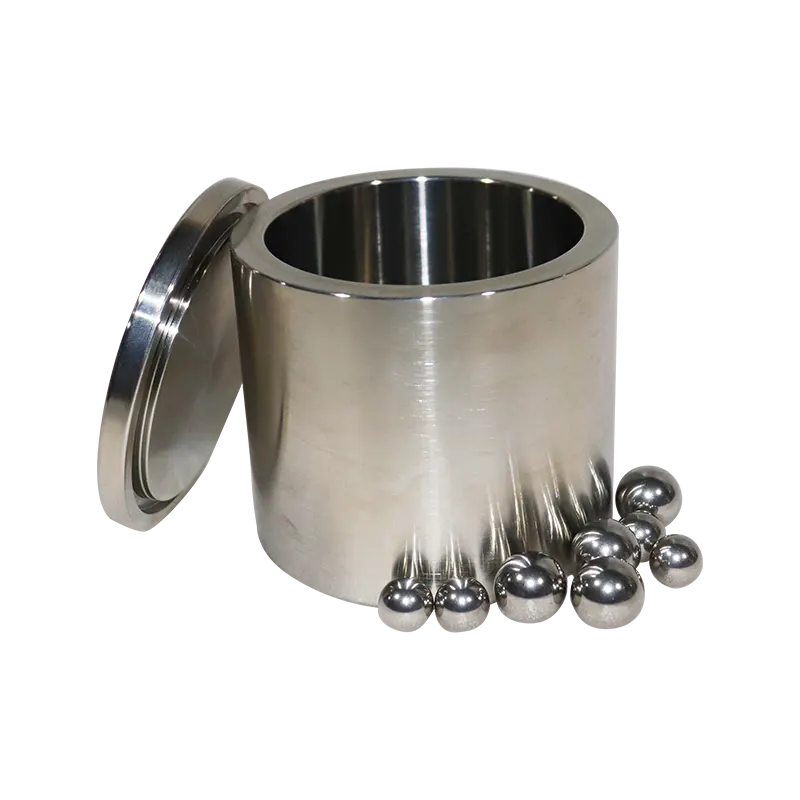
Start with a contamination budget, not a catalog page. List the elements your analytical method cares about, the hardness of your powder, the mass of your batch, and the cleaning validation you can actually perform. If iron is a critical analyte, a stainless steel jar should not be the default. If your powder is abrasive, the jar material must not become the wear part. If your method can tolerate a metallic contact surface, a defined stainless steel jar can serve as a controlled baseline for method development. The 304 stainless steel planetary mill jar is one option in that decision space. Use its material identity as a starting point, then confirm the configuration and compatibility for your powder. Do not choose it because it is common. Choose it because your powder, media, and analytical method make that material an acceptable part of the system.
2. Pair media density and ball size with the jar
The grinding balls are the other half of the wear pair. Media density changes the impact energy per collision. Ball diameter distribution changes the number of contacts and the surface area available for milling. A dense media in a soft jar can polish the wall. A light media may force you to mill longer, which adds wear over time. The right media does the milling work in the powder, not in the jar wall. This is also why changing ball-to-powder ratio alone can fail: you may be increasing the number of collisions without fixing the material match that controls where the wear goes.
3. Specify the inner-wall finish and cleanability
Ask for an inner surface that can be inspected, cleaned, and verified. A polished, crevice-free jar with generous internal radii is not a cosmetic upgrade. It removes the places where powder can hide and where cleaning cannot reach. The lid, seal area, and any internal step deserve the same scrutiny as the cylindrical wall. If you cannot see the surface, you cannot qualify it. A jar that is easy to inspect is part of your metrology, not just your hardware.
4. Treat the seal as a material choice
For inert-atmosphere milling, specify a seal material that is compatible with your process and replaceable in routine maintenance. Validate it with a leak check and with a blank run that looks for seal debris. If the seal is not part of the specification, it becomes an uncontrolled variable that only shows up when a batch fails.
5. Qualify the host, jar, and balls as one set
Record the jar material, media material, ball size distribution, jar lot, and surface condition. Run a qualification batch with your actual powder and measure the contamination markers you care about. Inspect the wall after the run. Repeat the batch without changing the process. If the result moves, you have a wear or residue problem, not a speed problem. If you must change a component, change one at a time and keep the old data as a baseline. This is how you build repeatability into the method instead of hoping for it.
What Changes When the Jar and Balls Are Part of the Method
The payoff is not a single perfect number. It is a method that behaves like a method. You get batch-to-batch repeatability because the wear path is stable and the jar can be cleaned to a verifiable condition. You get data you can publish because the contamination source is identified and controlled. You stop losing expensive powder to wall wear and hidden residue. And when it is time to scale up, you have a basis for the decision: the same material logic, the same media logic, and the same surface logic can be checked at the next size.
You also change the conversation with your supplier. Instead of asking for a mill and then hunting for a jar, you ask for a host-jar-media package that matches your powder. You ask where the wear goes, how the jar is cleaned, and how the media was selected. Those questions are harder to answer than a speed range, and that is exactly why they matter.
Before You Run Another Batch
If three runs disagree, do not start with another speed trial. Inspect the jar wall under oblique light. Look for scratches, seams, discoloration, and packed powder in corners. Check the balls for dull patches, chipping, or transferred material. Run a cleaning validation that looks at the surface, not only the rinse. Review your elemental data for jar or media markers. Then decide whether you have a process problem or a component problem.
If you are specifying a new jar, bring the failure with you: the powder, the contamination limit, the sample mass, the cleaning method, and the scale-up target. A jar that is selected against those constraints is more likely to make your next three runs agree. That is the real selection rationale for a co-designed planetary ball mill setup: not a bigger machine, but a wear system you can specify, clean, and defend in a review meeting.