
Technical article
Planetary Ball Mill Contamination Starts in the Jar and Balls
Contamination and drifting particle size often begin in the grinding jar and media, not in speed settings alone.
The failure loop you keep repeating
You load the same powder, set the same speed, use the same time, and keep the ball-to-powder ratio unchanged. The first run looks acceptable. The second run is a little darker. The third run has an elemental result you cannot explain, a particle-size curve with a tail that will not close, or a yield that is lower than the mass balance allows. You check the log. Nothing obvious changed.
So you do the reasonable thing. You treat the result as a process problem and try to tune it out. You run longer to grind finer. You lower the speed to reduce damage. You change the ball-to-powder ratio. You clean the jar for another twenty minutes. Each adjustment produces a new result, but not a stable one. The next batch drifts again.
That is the failure loop: you keep changing process variables while the hardware stays the same. Four common fixes feel productive, but they often miss the source:
- Increase milling time to push the particle-size tail down.
- Reduce rotation speed to protect the sample.
- Change the ball-to-powder ratio to alter impact energy.
- Clean the jar longer because the rinse water looks clear.
None of these fixes is wrong in principle. They become ineffective when the real variable is the grinding jar and the grinding balls. A planetary ball mill does not grind in a neutral container. The jar wall and the media are part of the grinding chamber, and they experience the same high-energy impacts as the powder. If you never isolate that part of the system, you are adjusting the process around a contamination source you have not named.
The variable you have not isolated: where the wear goes
In a planetary ball mill, the jar rotates around its own axis while the sun disk turns in the opposite direction. The balls rise, fall, and collide with the wall and with each other at high frequency. That is the energy you want. It is also energy that acts on the jar surface and the media surface. Wear is not evidence that you are running the mill incorrectly. It is a consequence of transferring energy into a confined chamber. The useful question is not whether wear occurs, but where the wear products go.
There are three destinations, and each one can change your data. First, wear debris can enter the powder directly and become part of the sample. Second, fine material can smear, embed, or compact into the jar wall, especially where the surface is scratched or rough. Third, powder can lodge in seams, radius transitions, and seal grooves. A rinse may remove the visible layer while leaving the third destination untouched. When you run the next batch, that retained material can release slowly into the new powder.
This is why a particle-size tail can persist even when you change the milling time. The tail may not be a true fine fraction from your powder. It may contain wear debris, compacted old powder, or agglomerates formed around foreign particles. It is also why trace samples are less forgiving. A wear amount that disappears in a kilogram batch becomes a measurable fraction in a few grams. At that scale, the jar and balls are not background hardware. They are active participants in the result.
Defect one: jar and media wear contamination
Mechanism: a hardness mismatch turns the jar into a contamination source
When the powder is harder than the jar wall, or when the grinding media are not matched to the powder and the jar, the ball does not only hit powder. It hits the wall through a thin powder layer, and powder particles are caught at the contact point. If the jar material is softer than the powder or the media, abrasion removes jar material and transfers it into the batch. If the media are the weaker component, the balls themselves become the source. The contamination does not have to be visible as a cloud of dust. It can be a fine, distributed fraction that changes the chemistry of the sample.
Iron-sensitive powders make this failure easy to see because an iron-bearing jar or ball can show up as an unexpected Fe increase. But the same logic applies to Zr, Al, and other elements associated with jar or media materials. The element result is only the symptom. The mechanism is a wear pair: powder, media, and wall in sustained high-energy contact. If the material combination is wrong, the mill is not just reducing particle size. It is generating a new powder from the hardware.
Effect on data: element anomalies and a distribution that will not settle
You may see an elemental analysis that is higher than the certificate of the starting powder, a color shift after milling, or a magnetic response that was not present before. You may also see three runs with the same recipe diverge from one another. That divergence is not always an operator error. Wear is path-dependent. A new jar wears differently from an aged jar. A ball that has lost surface material transfers energy differently. A jar that has been cleaned aggressively may have a fresh scratch pattern that traps more powder. The process log looks identical, but the wear state is not.
The particle-size result can be misleading in the same way. Wear debris may be counted as fine particles, or it may act as a nucleus for agglomeration. You increase milling time to reduce the coarse fraction, and the tail moves but does not disappear. You lower the speed to reduce breakage, and the chemistry still drifts. The distribution is responding to a source that is not described by speed, time, or ratio alone.
Why process adjustment cannot repair a material mismatch
Lowering the rotation speed reduces energy, but it does not stop contact between the media, the powder, and the wall. Increasing milling time adds more impacts and more wear opportunity. Changing the ball-to-powder ratio changes the number and energy of collisions, but it does not change the fact that the jar material is incompatible with the powder. Cleaning removes what you can reach, not what has been embedded or chemically attached to the surface.
This is the hard limit of process tuning. You can make a contaminated result more repeatable by fixing the wear rate, but you cannot make it pure by adjusting the recipe. If the contamination is coming from the jar and balls, the process window is the wrong place to look. The material pair is the variable that must change first.
Defect two: structural retention and cross-contamination
Mechanism: scratches, seams, and seal grooves are traps
A jar can be made from a wear-resistant material and still fail the batch because of geometry. The inner wall may look smooth, but high-energy impact leaves micro-scratches over time. Powder is pressed into those scratches under load. Seams and radius transitions create dead zones where the balls cannot sweep cleanly. If the jar uses a seal, the groove around the seal is another trap. Powder can compact into the groove, and a cleaning brush may pass over the opening without reaching the bottom.
This is not ordinary surface dirt. It is material that has been mechanically keyed into the wall or trapped behind a geometric feature. A solvent rinse can dilute the visible residue and still leave a film in the scratch. The next batch may look clean at the start and become contaminated at the end, when the retained material is gradually released into the powder.
Effect on data: ghost contamination and a false tail
Structural retention produces a specific pattern. The first batch after cleaning may be acceptable. The second batch shows a small impurity peak or an unexpected phase. The third batch has a tail that appears in a size range you did not put in. If you change from a hard powder to a softer one, old hard particles can survive the new run and appear as outliers. If you change from a dark powder to a light one, a small amount of retained dark material becomes visible in the final color.
This is ghost contamination: the previous batch is still present in the system even though the jar was rinsed. It can also distort mass balance. You recover less powder than you loaded because some of it is held in the jar, and you recover more contamination than you expect because the jar is releasing old material. The result is a data set that looks like a process problem but behaves like a cleaning and geometry problem.
Why longer cleaning cannot fix a geometry problem
Cleaning time is not the same as cleaning access. If a scratch is deep enough, or a seal groove is narrow enough, a longer wash cycle only gives the solvent more time to reach the opening. It does not guarantee that the solvent reaches the bottom. Aggressive cleaning can make the problem worse by creating new scratches or wearing the seal. The correct fix is not more cleaning effort. It is a surface and geometry that can be cleaned in the first place, with a seal that can be inspected and replaced.
The trace-sample multiplier
Gram-scale milling amplifies every wear and retention problem. In a large batch, a few milligrams of jar material may be lost in the noise. In a five-gram batch, the same few milligrams become a significant concentration. The sample is small, but the jar wall area and ball surface area are not proportionally small. You are using a high-energy chamber to mill a thin layer of powder, and much of the energy is still delivered to the hardware.
This is also why expensive or high-purity powder is vulnerable. The material you care about is not only contaminated. It is retained on the wall, compacted into scratches, and trapped in the seal groove. The yield loss and the contamination come from the same place. If the powder is difficult to replace, the cost of a poorly matched jar is not only the failed analysis. It is the lost sample, the repeated run, and the delay in the project.
What a coordinated mill-jar-ball design changes
A coordinated planetary ball mill setup treats the mill, the jar, and the grinding balls as one grinding system. The point is not to buy the most expensive component. The point is to make the material pair, the surface condition, and the cleaning access agree with the powder and the data requirement.
1. Jar material matched to powder chemistry and hardness
The jar material must be chosen against two limits: it must survive the powder, and its wear products must be acceptable in the sample. A wear-resistant jar that releases an element you cannot tolerate is still the wrong jar. An iron-sensitive powder should not be run in an iron-bearing jar if the contamination budget is tight. A high-hardness powder needs a jar that will not be abraded into the batch. The selection should start with the allowed contamination list, not with a generic hardness ranking.
2. Media material, density, and ball diameter chosen as a set
The grinding media transfer energy, but they also determine where that energy lands. Density changes impact momentum. Ball diameter changes the number of contact points and the local stress at the wall. A larger ball may break coarse particles faster, but it can also concentrate force and increase wall wear. A smaller ball may improve contact frequency, but it may not carry enough energy for a hard powder. Media selection is therefore a balance between grinding efficiency and wear contribution.
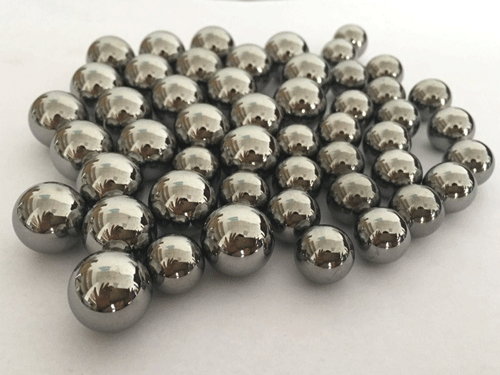
For wear-sensitive or high-hardness powders, media should be evaluated against the jar and the powder together. Tungsten carbide mill balls are one option to consider when a hard, dense grinding medium is needed and the acceptable wear profile has been defined. They are not a universal default. The right decision depends on the jar material, the powder chemistry, the ball size, and the energy the mill will deliver.
3. Polished internals and cleanable geometry
Surface finish and geometry directly answer the structural retention problem. A polished inner wall reduces the sites where powder can key into the surface. Rounded transitions are easier to sweep than sharp corners. A jar without blind grooves gives the balls a chance to clean the wall during the run and gives you a chance to inspect it afterward. If the design includes a seal, the groove should be accessible for inspection and replacement, not hidden behind a fixed shoulder.
4. Seal material and groove design for sealed jars
If you use an inert-atmosphere jar, the seal is a wear part, not a permanent feature. The seal material must be compatible with the powder and the cleaning solvent, and the groove must allow you to see whether powder has compacted behind it. A worn seal can leak atmosphere or shed particles into the batch. Either outcome makes the run difficult to compare with the previous one. Seal selection belongs in the same conversation as jar material and media selection.
5. Revalidate the process window after the hardware change
When you change the jar, the balls, or the surface condition, you have changed the energy path. Do not copy the old speed and time and assume the result will transfer. Run a blank or a representative powder, inspect the wall and media, and confirm that the new combination is stable across repeated batches. The goal is not a single good run. The goal is a wear state and a cleaning state that you can reproduce.
What changes when the jar, ball, and mill are treated as one system
When the hardware is matched, the conversation shifts. You stop asking which speed setting will hide the tail and start asking which material pair and surface condition will keep the sample representative. The practical gains are concrete:
- Batches repeat because wear and retention are controlled, not masked by process changes.
- Element results and particle-size distributions become defensible because the contamination source has been addressed.
- Expensive powder is not consumed by the wall, the media, and the seal groove.
- Scale-up has a basis beyond a copied recipe: jar material, media density, ball diameter, surface finish, and seal design are known variables.
Before you adjust the speed again, inspect the jar wall under oblique light. Look for scratches, polished bands, and dark material in the radius. Check the media for surface loss. Check the seal groove if your jar has one. Then ask what the wear products are and where they can go. A short technical review of your powder, jar, and media combination is more useful than another parameter sweep. The right question is not which setting hides the contamination. It is which jar and ball system keeps the contamination out of the data.