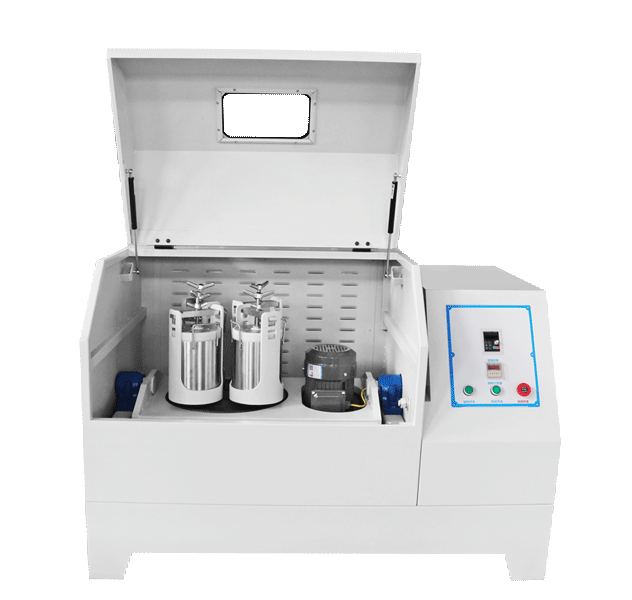
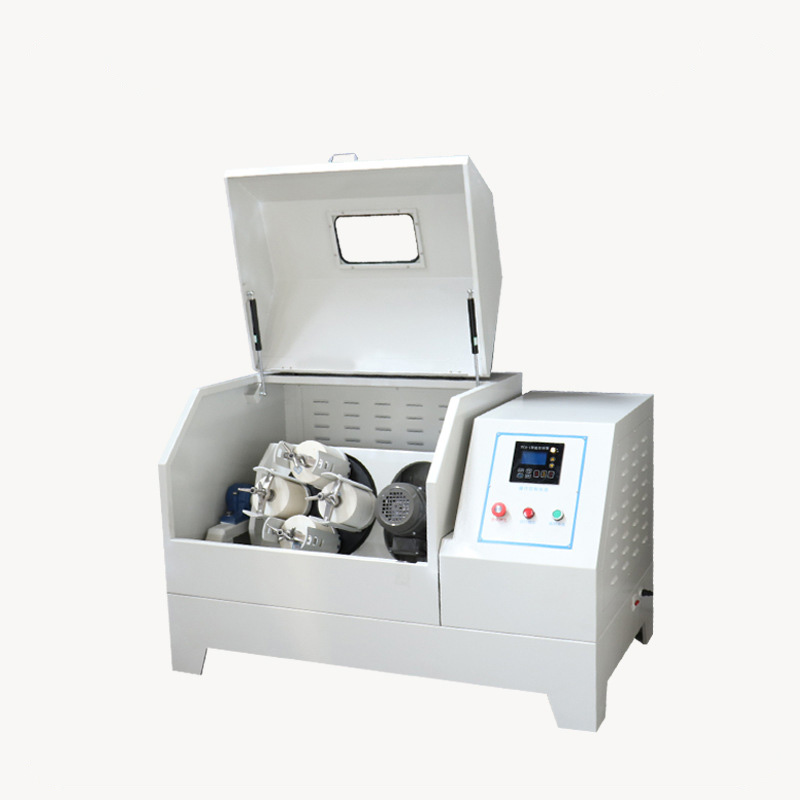
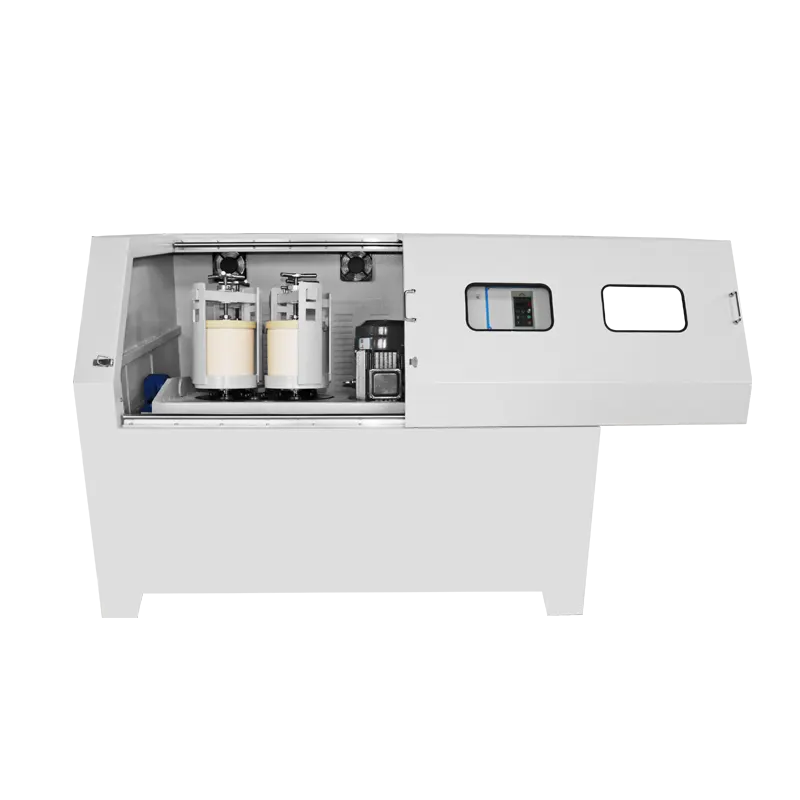
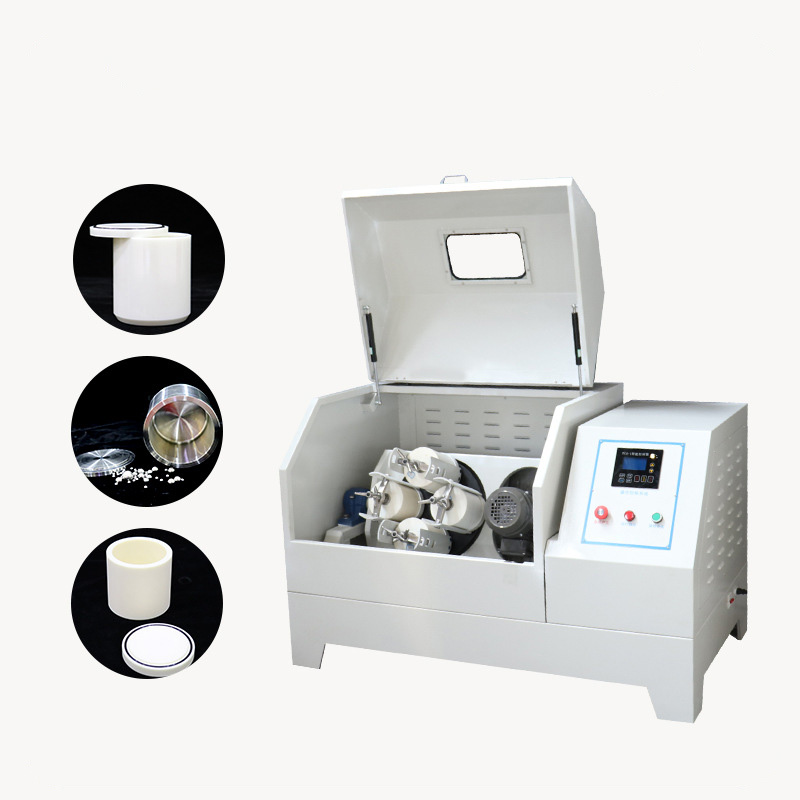
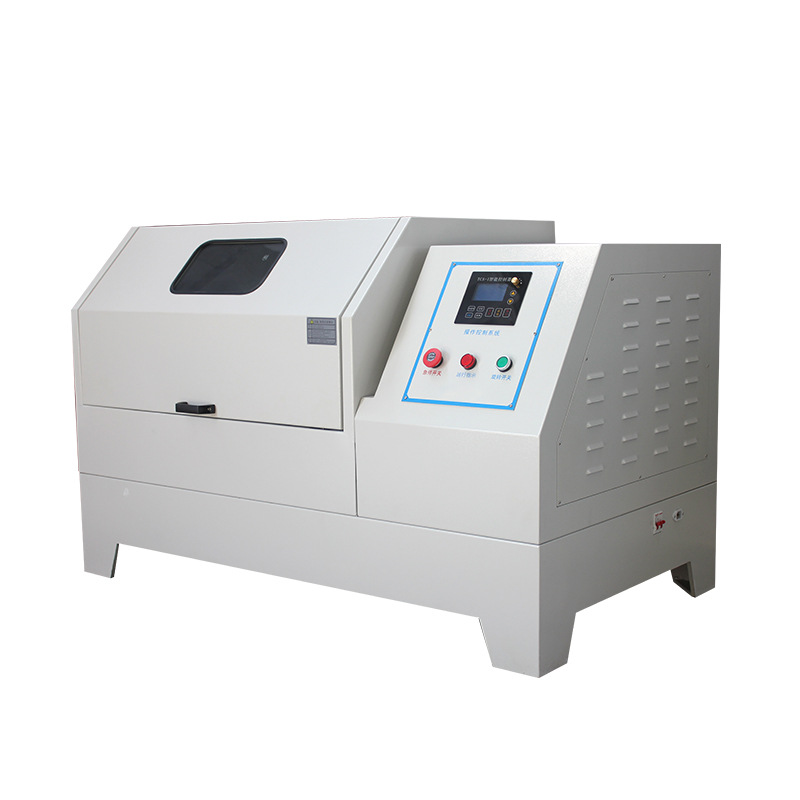
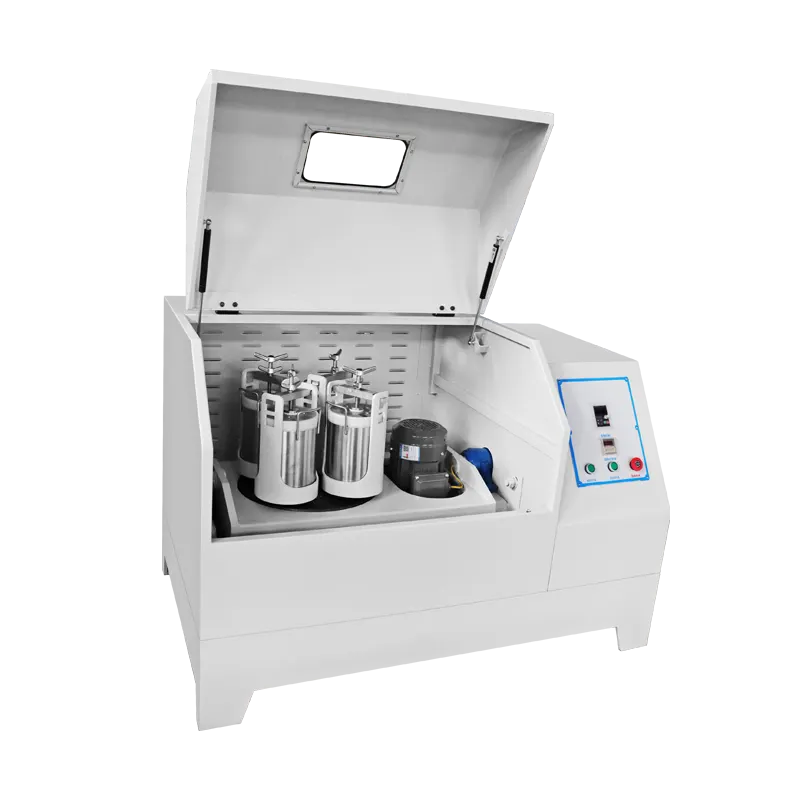
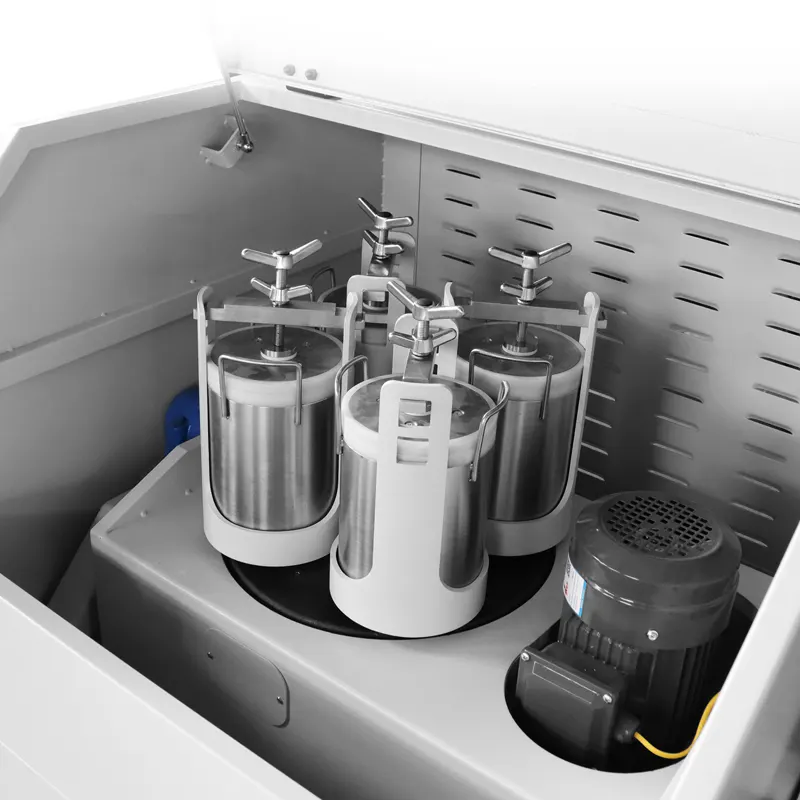
An omnidirectional planetary mill that adds a tumbling motion to the revolving disc and rotating jars. It is intended for laboratory work where sample movement, settling or adhesion needs closer attention.
How it works
Planetary milling continues while the assembly changes orientation through a 360° tumbling motion. This changes the direction of gravity relative to the jar contents; it does not guarantee that every material will remain dispersed.
Key features
Published laboratory QXQM models range from 0.4 L to 12 L nominal capacity.
The tables list four jar positions, compatible jar sizes and model-specific speed, power and mass.
The product information offers conventional or touchscreen/PLC control arrangements, subject to the supplied configuration.
Specifications
Published catalog references are reproduced below. Nominal volume is not a sample-mass rating. Confirm the selected model, material grade, electrical supply and complete supplied configuration in the quotation.
Model specifications — 1
Model
Nominal capacity
Compatible jar volume
Jar positions
Compatible vacuum jar volume
QXQM-0.4
0.4L
25-100mL
4
—
QXQM-1
1L
50-250mL
4
—
QXQM-2
2L
50-500mL
4
50-250mL
QXQM-4
4L
0.25-1L
4
50-500mL
QXQM-6
6L
1-1.5L
4
50-1000mL
QXQM-8
8L
1-2L
4
50-1500mL
QXQM-10
10L
1-2.5L
4
1-2L
QXQM-12
12L
1-3L
4
1-2L
Model specifications — 2
Model / nominal volume
Electrical supply
Motor power (kW)
Programmable run time (min)
Reversing interval (min)
Adjustable speed / Revolution speed (rpm)
QXQM-0.4
220V-50Hz
0.25
1-9999
1-999
45-435
QXQM-1
220V-50Hz
0.75
1-9999
1-999
0-405
QXQM-2
220V-50Hz
0.75
1-9999
1-999
0-405
QXQM-4
220V-50Hz
0.75
1-9999
1-999
0-405
QXQM-6
220V-50Hz
0.75
1-9999
1-999
0-335
QXQM-8
220V-50Hz
1.5
1-9999
1-999
0-290
QXQM-10
220V-50Hz
1.5
1-9999
1-999
0-290
QXQM-12
220V-50Hz
1.5
1-9999
1-999
0-290
Model specifications — 3
Model / nominal volume
Adjustable speed / Jar rotation speed (rpm)
Published noise level (dB)
QXQM-0.4
90-870
—
QXQM-1
0-810
60±5
QXQM-2
0-810
60±5
QXQM-4
0-810
60±5
QXQM-6
0-670
60±5
QXQM-8
0-580
60±5
QXQM-10
0-580
60±5
QXQM-12
0-580
60±5
Model specifications — 4
Model / nominal volume
Motor power
Speed control
Revolution : rotation ratio
Machine mass (kg)
Dimensions (mm)
QXQM-0.4
250W
Variable-frequency control
1:2
136
900*570*667
QXQM-1
0.75kW
Variable-frequency control
1:2
305
1330*810*860
QXQM-2
0.75kW
Variable-frequency control
1:2
305
1330*810*860
QXQM-4
0.75kW
Variable-frequency control
1:2
305
1330*810*860
QXQM-6
0.75kW
Variable-frequency control
1:2
305
1330*810*860
QXQM-8
1.5kW
Variable-frequency control
1:2
430
1360*850*930
QXQM-10
1.5kW
Variable-frequency control
1:2
430
1360*850*930
QXQM-12
1.5kW
Variable-frequency control
1:2
430
1360*850*930
Model specifications — 5
Parameter
Published reference
Drive
Gear drive
Jar arrangement
Two or four jars simultaneously
Published combined sample + media limit
Up to two-thirds of jar volume, sample and media combined
Speed control
Stepless variable-frequency control
Applications
Powder mixing, materials research and trials involving samples that settle, cake or adhere during conventional planetary milling.
Suitability depends on the actual sample, process and analytical requirements; a listed application is not a guaranteed final-particle-size result.
Accessories and options
Discuss compatible jars, media, vacuum arrangements and the control interface. Cooling and other assistance need to be specified for the chosen QXQM model.
Jar and media: confirm material, volume, holder fit and the complete working load.
Vacuum or gas requirements: specify the complete jar, lid and seal arrangement; no pressure rating is assumed.
Utilities and supply scope: state voltage, frequency, phase, destination and required documents; confirm included versus optional items.
Consider the sample’s flow and adhesion behaviour, jar size and the permitted mass of the complete jar assembly. Review a trial before assuming that tumbling will solve a material-specific problem.
QXQM; exact capacity not recorded · Dry milling; horizontal configuration recorded
Sample: 120 g
Jar: 500 mL
Recorded sampling / duration: 150 min
Recorded observations
Observation
Sampling time
D50 (µm)
D90 (µm)
Recorded sample
150 min
1.33
2.74
The record identifies QXQM, not WXQM or a production QXQM capacity. D99 was requested but not reported. Atmosphere, contamination and measurement methods need confirmation.
How to plan a fair comparison
Request a matched comparison of conventional and tumbling operation. Keep the sample, jar, media and measurement procedure consistent, and record wall adhesion and temperature as well as particle size.
These anonymous records are not operating instructions. Measurement and dispersion methods are not fully specified in the test summaries; results apply to the reported samples and conditions.
Is omnidirectional milling the same as a horizontal planetary mill?
No. This QXQM configuration adds assembly tumbling to planetary motion. A horizontal WXQM machine uses horizontally mounted jars on a vertically arranged disc; the mechanisms and model specifications are different.
How should I select the QXQM laboratory series configuration?
Consider the sample’s flow and adhesion behaviour, jar size and the permitted mass of the complete jar assembly. Review a trial before assuming that tumbling will solve a material-specific problem. Published laboratory QXQM models range from 0.4 L to 12 L nominal capacity. Nominal mill capacity is not the usable sample mass; account for media and working space.
Which jars and grinding media should I request for this mill?
Laboratory QXQM models have four jar positions. Check the compatible jar and vacuum-jar volumes for the selected 0.4–12 L model. Choose the jar working material and media around sample chemistry and contamination limits; confirm the complete loaded mass.
Are cooling and ultrasonic equipment included?
Discuss compatible jars, media, vacuum arrangements and the control interface. Cooling and other assistance need to be specified for the chosen QXQM model. Optional equipment is included only when it is explicitly listed in the agreed configuration and quotation.
What trial evidence is available for this mill?
Lithium iron phosphate: QXQM; exact capacity not recorded, 120 g in 500 mL, 150 min. The record identifies QXQM, not WXQM or a production QXQM capacity. D99 was requested but not reported. Atmosphere, contamination and measurement methods need confirmation. A free sample-grinding application can be reviewed by TENCAN engineers.
What should I include in an export quotation request?
Specify QXQM laboratory series, sample and jar requirements, destination, mains voltage, frequency and phase. Consider the sample’s flow and adhesion behaviour, jar size and the permitted mass of the complete jar assembly. Review a trial before assuming that tumbling will solve a material-specific problem. Confirm included accessories, packing, required documents, commercial terms and lead time in the quotation.
Start with your sample.
Nominal capacity, jar volume and usable sample load are different. Confirm the model, jars and electrical requirements with our engineers.