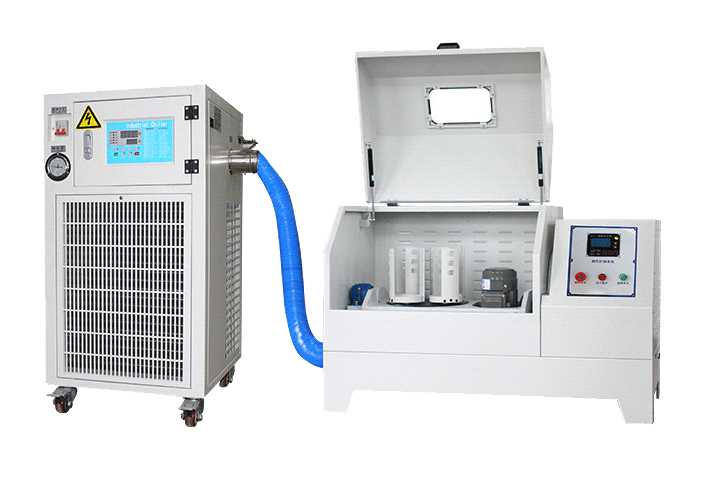
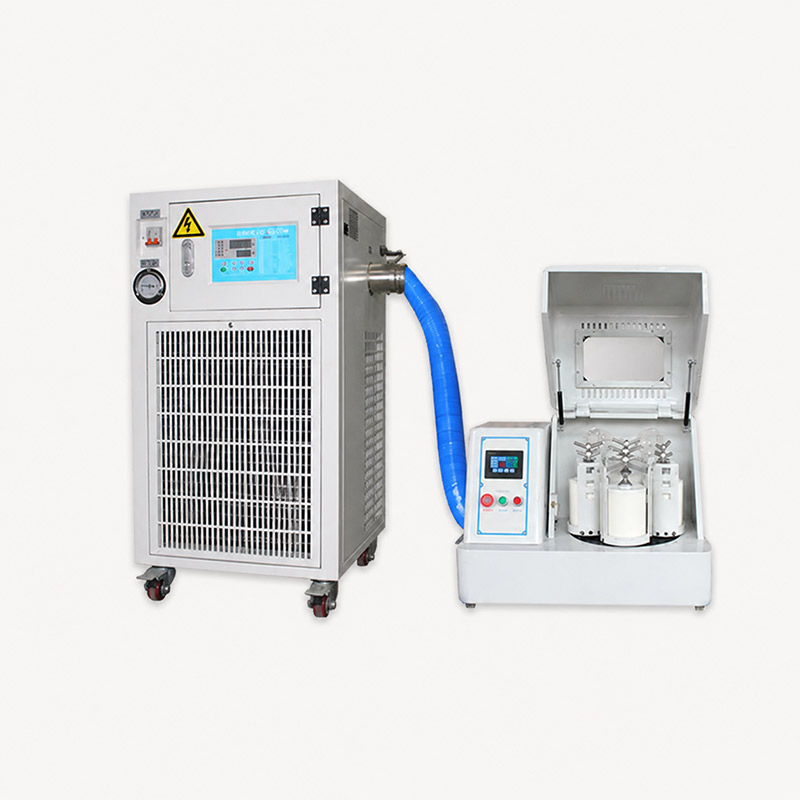
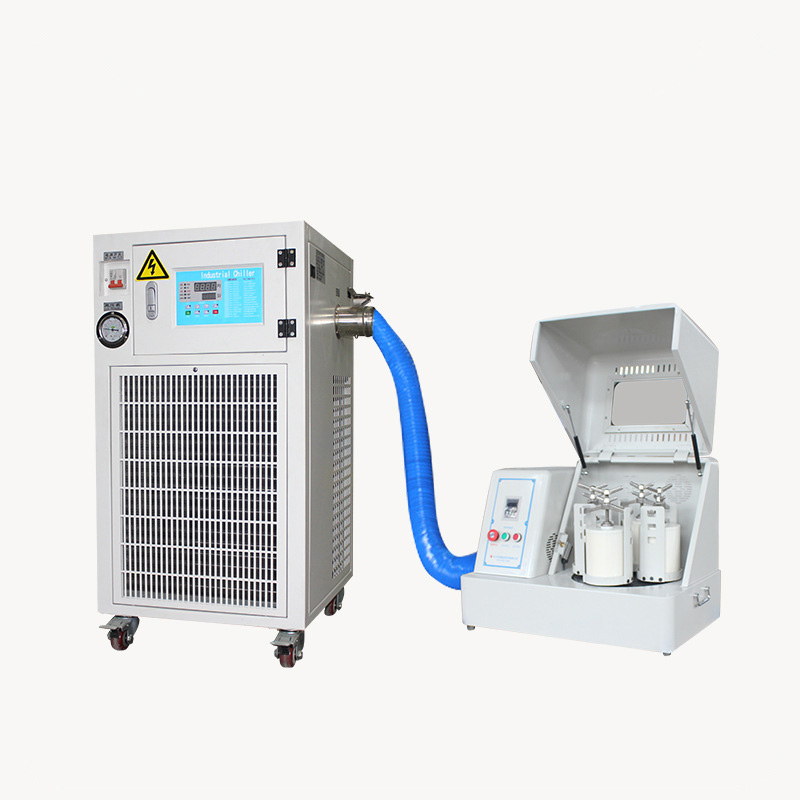
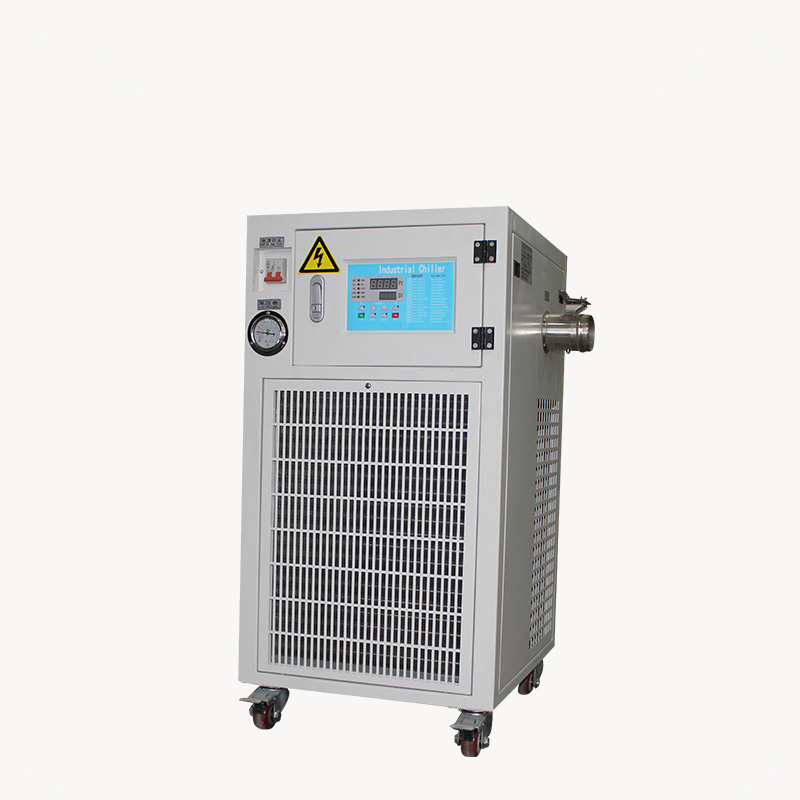
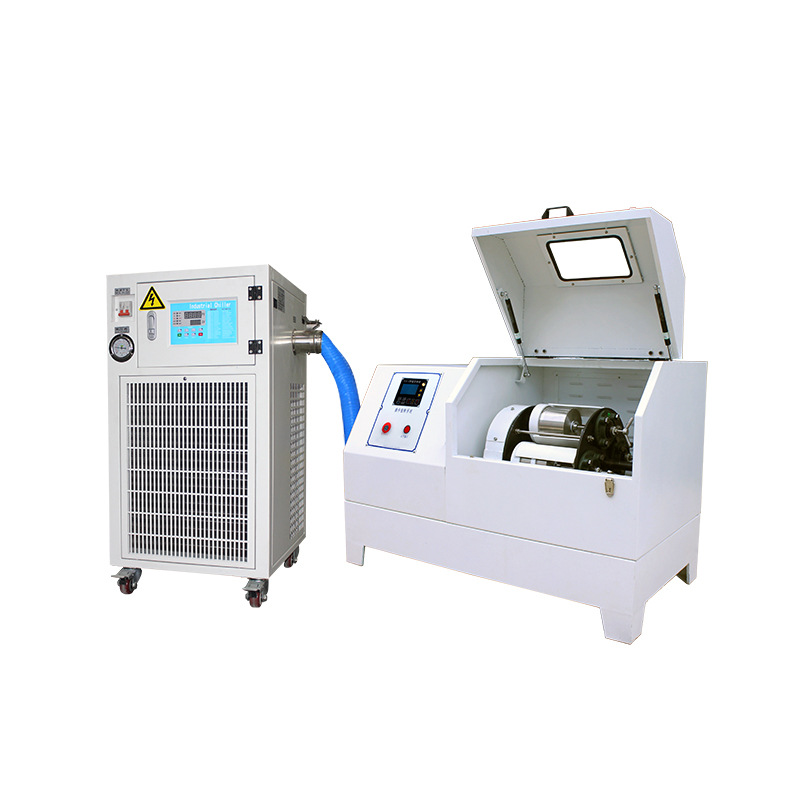
A planetary mill combined with a refrigerated air-cooling unit. It provides a way to manage the working environment around the milling assembly when heat generation is part of the selection problem.
How it works
Refrigerated air circulates around the milling area to remove heat. The product information describes a 5–15 °C working-area reference, while actual sample temperature depends on the base mill, cooling capacity and operating conditions.
Key features
Air cooling is a system configuration, rather than a single universal mill model.
The product information describes compatibility proposals for vertical, omnidirectional and horizontal planetary platforms.
Working-area temperature and temperature inside the sample are separate quantities.
Specifications
Published catalog references are reproduced below. Nominal volume is not a sample-mass rating. Confirm the selected model, material grade, electrical supply and complete supplied configuration in the quotation.
Air-cooled system reference
Item
Published description
Cooling method
Refrigerated air circulation around the working area
Working-area temperature reference
5–15 °C; depends on equipment and operating conditions
Permitted base platforms
Vertical, omnidirectional and horizontal proposals; confirm the exact configuration
Drive reference
Gear-driven planetary base
Jar arrangement reference
Two or four jars operating together
Published combined sample + media limit
Up to two-thirds of jar volume; actual working load must be checked
Cooling power / supplied utilities
Confirm for the selected base mill and cooling unit
Sample-temperature measurement
Location and test conditions to be agreed
Applications
Temperature-sensitive milling studies and processes in which frictional heating changes sample behaviour.
Suitability depends on the actual sample, process and analytical requirements; a listed application is not a guaranteed final-particle-size result.
Accessories and options
Specify the base planetary platform, cooling unit, jar and media combination, and required controls. Confirm the supplied electrical arrangement and installation requirements for the complete system.
Jar and media: confirm material, volume, holder fit and the complete working load.
Vacuum or gas requirements: specify the complete jar, lid and seal arrangement; no pressure rating is assumed.
Utilities and supply scope: state voltage, frequency, phase, destination and required documents; confirm included versus optional items.
Provide the sample temperature limit, room conditions, intended operating schedule and proposed base mill. Agree where temperature will be measured before comparing cooling arrangements.
XQM with air-cooling equipment · Wet milling with air assistance
Sample: 60 g
Jar: Volume not recorded
Recorded sampling / duration: 60 min sample
Recorded observations
Observation
Sampling time
D50 (µm)
D90 (µm)
Recorded sample
60 min
9.40
18.20
Air-cooling equipment is explicitly mentioned, but no base-model number, jar temperature or uncooled control is reported. The 80 min total includes further processing after the 60 min measured sample.
Recorded process configuration
Polyethylene glycol
XQM with air-cooling equipment · Successive dry-milling observations
Sample: 12 g
Jar: 250 mL PTFE jar; agate media
Recorded sampling / duration: Four successive 30 min stages
Recorded observations
Stage
Speed setting (as recorded)
Recorded jar temperature (°C)
1
100
20
2
200
19
3
300
20
4
500
25
The speed reference/unit and temperature sensor position are not fully documented. Speed and cumulative processing time both changed, so this is not a controlled speed-only experiment. No particle-size result was obtained. It illustrates why cooling-area and sample/jar temperatures must be distinguished.
How to plan a fair comparison
Request matched cooled and uncooled runs with sample-temperature logging. Existing air-cooled records are observations under their recorded conditions, not a controlled proof of a universal cooling advantage.
These anonymous records are not operating instructions. Measurement and dispersion methods are not fully specified in the test summaries; results apply to the reported samples and conditions.
Does a 5–15 °C working-area reference guarantee the same sample temperature?
No. It describes the working area, not a guaranteed temperature at every point inside the jar. The supplied workbook includes air-assisted runs with separately recorded jar temperatures, illustrating why the measurement location matters.
How should I select the Air-cooled planetary configuration configuration?
Provide the sample temperature limit, room conditions, intended operating schedule and proposed base mill. Agree where temperature will be measured before comparing cooling arrangements. Air cooling is a system configuration, rather than a single universal mill model. Nominal mill capacity is not the usable sample mass; account for media and working space.
Which jars and grinding media should I request for this mill?
The cooling proposal can use different base platforms. Specify the base mill first, then confirm the jar, cooling access and temperature measurement. Choose the jar working material and media around sample chemistry and contamination limits; confirm the complete loaded mass.
Are cooling and ultrasonic equipment included?
Specify the base planetary platform, cooling unit, jar and media combination, and required controls. Confirm the supplied electrical arrangement and installation requirements for the complete system. Optional equipment is included only when it is explicitly listed in the agreed configuration and quotation.
What trial evidence is available for this mill?
Ammonium bicarbonate: XQM with air-cooling equipment, 60 g in Volume not recorded, 60 min sample. Air-cooling equipment is explicitly mentioned, but no base-model number, jar temperature or uncooled control is reported. The 80 min total includes further processing after the 60 min measured sample. A free sample-grinding application can be reviewed by TENCAN engineers.
What should I include in an export quotation request?
Specify Air-cooled planetary configuration, sample and jar requirements, destination, mains voltage, frequency and phase. Provide the sample temperature limit, room conditions, intended operating schedule and proposed base mill. Agree where temperature will be measured before comparing cooling arrangements. Confirm included accessories, packing, required documents, commercial terms and lead time in the quotation.
Start with your sample.
Nominal capacity, jar volume and usable sample load are different. Confirm the model, jars and electrical requirements with our engineers.