
Technical article
Why Your Planetary Ball Mill Contamination Starts at the Jar
Jar wear, wall residue and media mismatch — not speed or time — drive contamination in planetary ball milling.
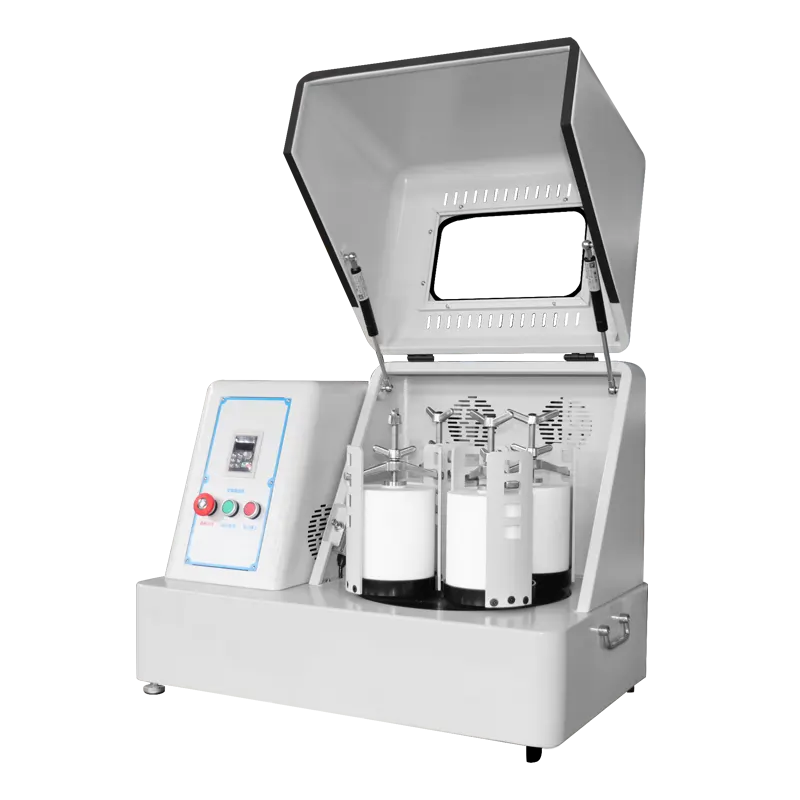
You Have Already Tried Everything on the Panel
You ran the same powder three times on the same planetary ball mill, at the same recorded speed, for the same milling time, with the same ball-to-powder ratio — and you got three different particle size distributions. The third run tailed out past your specification window. You re-checked the protocol, re-zeroed the balance, and ran it a fourth time. It came back different again.
So you did what nearly every laboratory does first. You changed the parameters.
- You raised the rotation speed, on the theory that more energy means faster comminution and a tighter distribution.
- You extended the milling time, on the theory that the coarse tail simply needed more passes under the media.
- You changed the ball-to-powder ratio, adding more media to increase collision frequency.
- You extended cleaning — longer solvent soaks, more sonication, a fresh wipe-down between batches — to chase the iron and zirconium that kept appearing in the elemental scan.
Some of those changes moved the number. None of them moved it consistently. And the more carefully you logged the parameters, the clearer it became that the parameters were not the thing that was varying. The mill behaved like a system with an uncontrolled variable, and you kept adjusting the controlled ones.
The Variable Is Inside the Jar
A planetary ball mill works by pushing a large amount of energy into a very small volume. The grinding jar spins around its own axis while the sun wheel turns in the opposite direction; the resulting centrifugal and Coriolis forces carry the media up the inner wall and drive them back down into the powder bed at high relative velocity. That is exactly why the technique is so effective for sub-micron comminution, mechanical alloying and amorphization.
It is also why the jar wall and the grinding media are consumables in a physical sense, not merely an accounting one. Every impact that fractures a particle also lands on the wall and on the ball surface. A fraction of the energy always goes into the tooling. So the question that decides whether your data is reproducible is not whether wear happens — it is where the wear products go, where residue hides, and whether a gram-scale sample can absorb it.
That last point is the one most often missed. In a production mill running kilograms of powder, a few milligrams of abraded jar material is a rounding error. In a laboratory planetary ball mill running a 2 g or 5 g charge, those same few milligrams become a concentration that appears directly in ICP-MS, in XRF, in magnetic separation yield, and in the background of your diffraction pattern. The smaller the batch, the more the jar becomes part of the sample.
Once you accept that framing, the failure modes stop looking like process problems and start looking like component problems. Two of them account for most of the "it worked last month" cases in lab after lab.
Defect One: Your Jar and Media Are Being Milled Along With Your Sample
The mechanism: hardness mismatch under high-energy impact
In a planetary mill, the abrasive conditions inside the jar are severe by design. If the jar material is softer than, or comparable in hardness to, the powder you are milling — a hard oxide, a carbide, a silicate, a metal alloy — the powder acts as the abrasive and the wall acts as the workpiece. Impact energy that should be refining your particles is instead cutting into the inner wall and rounding the media. The abraded material has nowhere to go. It reports to the powder bed, and it stays there.
The reverse mismatch causes a different problem. A jar that is harder than necessary but chemically incompatible with your sample, or a jar chosen for convenience rather than compatibility, can still shed material at grain boundaries, at the base radius, and at the lid contact face where the geometry concentrates stress.
What it does to your data
You see it first as an anomaly rather than a number. A magnetic separation yield that is slightly too high. An iron or zirconium or aluminium signal in a sample that should contain none of it. A diffraction pattern with small unexplained reflections. A colour shift in a white powder. In a micro-batch, the contamination is not a trace — the wear debris concentration in a few grams of product can be orders of magnitude above what the same jar would contribute to a kilogram batch. Your expensive, high-purity precursor is being diluted by the very tool you chose to protect it.
Why re-tuning speed and time cannot fix it
Speed and time control the energy dose. They do not control where that energy is dissipated. Lowering the speed reduces the wear rate somewhat, but it also reduces comminution efficiency, so you end up running longer at a lower intensity and often generate a comparable total wear mass. Extending milling time increases the number of wall impacts linearly. Neither adjustment changes the hardness relationship between your powder and your jar, which is the actual root cause. You are tuning the symptom.
Defect Two: Structural Retention in Scratches, Seams and O-ring Grooves
Where residue actually hides
Look inside a jar that has been in service for a year, under oblique light. You will find a polished band where the media travel, and around it a network of fine scratches, a machined step at the base, a shoulder where the wall meets the lid seat, and a groove that carries the sealing ring. Each of those features is a reservoir. Powder is pressed into them by the same impact forces that mill it, and fine fractions — the ones you care most about — are the ones most easily trapped.
The cross-batch signature
This is the defect that produces the classic "same parameters, different result" complaint. Batch A leaves a few milligrams of hard, fine material in a scratch. Batch B is milled in the same jar, and that trapped material is progressively released into the new powder as the media work over the same surface. Batch B is therefore slightly coarser or slightly finer than intended, slightly off in composition, and slightly different from Batch C, which inherits a different residue load. Your recorded parameters are identical. Your starting conditions are not.
Why longer cleaning does not solve it
Cleaning reaches surfaces. It does not reliably reach geometry. A solvent soak dissolves what it can contact; a wipe removes what the cloth can touch. Neither removes compacted powder from the bottom of a scratch or from the inside of a sealing groove. In fact, aggressive cleaning can deepen the problem: abrasive cleaning media and hard scraping add new scratches, which add new reservoirs. The cleaning step grows longer every month while the batch-to-batch variance grows with it.
If you mill under inert atmosphere, add the seal to the list
For an inert-atmosphere grinding jar, the sealing ring is a wear part in its own right. Repeated compression cycles and solvent exposure harden and flatten it; the seal then leaks slowly, and your oxygen or moisture level drifts in a way that changes surface chemistry without changing any recorded setting. A degrading elastomer can also shed fragments into the jar. Choose the ring material against your actual atmosphere and your cleaning solvents, and treat it as a scheduled replacement item rather than a permanent fixture.
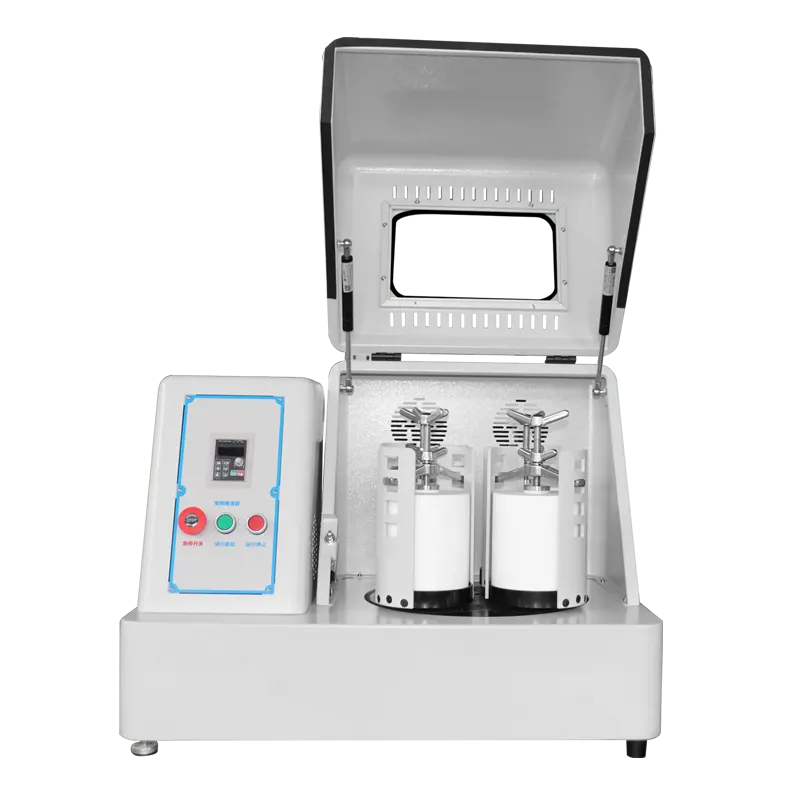
The Fix Is a Co-Selected System: Host, Jar and Media Together
If the diagnosis is component-level, the remedy has to be component-level too — but it cannot be a single component. The host, the jar and the media have to be chosen as one system, because each of them sets the operating conditions the others see. This is the design logic behind a Laboratory planetary grinder platform: the machine is specified around a defined jar and media set, so the energy dose you record corresponds to a known wear environment rather than an unknown one.
Match the jar material to the sample, not to the shelf
This is the direct answer to Defect One. Jar material selection should start from the hardness and the elemental sensitivity of your powder: what can be sacrificed as a contaminant, and what cannot. For iron-sensitive or magnetic materials, an iron-bearing jar is disqualified regardless of how well it mills. For hard ceramics, a soft jar simply becomes part of the product. For trace-element work, the jar must contribute elements that are either absent from your analysis list or present at levels far below your detection requirement. Decide the acceptable contaminant first, then pick the material.
Match the media by density and diameter, not by habit
Media density sets impact energy per collision; media diameter sets the number of collisions and the size of the fragments they can break. A dense, small-diameter charge delivers high specific energy with many contacts and is efficient for fine grinding, but it also loads the wall correspondingly. A light, large-diameter charge is gentler on the jar but leaves a coarse tail. The right combination is the one that reaches your target fineness with the fewest wall-directed impacts — and it must be the same material family as the jar, or you have simply moved the contamination source from the wall to the balls.
Specify interior finish and cleanable geometry
This is the direct answer to Defect Two. A polished, continuous inner surface with radiused transitions, no sharp internal step, and a lid seat that can be fully accessed removes the places where residue accumulates in the first place. Reproducibility then depends on a short, verifiable cleaning routine rather than a long, hopeful one. When the geometry is cleanable, validation of cleanliness becomes possible: you can inspect, you can swab, and you can prove the jar is ready.
Specify the sealing material only when you need it
If your protocol runs under inert gas, select the ring compound against your actual atmosphere, temperature and solvents, and build replacement into your maintenance interval. If your protocol runs in air, this variable drops out entirely — which is itself a reason to be explicit about which mode each jar in your cabinet is assigned to.
What Actually Changes in Your Lab
When the jar and media are matched to the powder and the geometry is designed to be cleaned, three things change at once, and none of them are marketing claims — they are the direct consequence of removing uncontrolled variables.
- Batches repeat. The run-to-run variance that survived every parameter adjustment disappears, because the residual load and the wear contribution are no longer drifting between batches.
- Data becomes publishable. A trace element result is defensible when you can state that the jar contributed no detectable amount of the elements you report, and when you can describe your cleaning validation.
- Expensive powder stays in your sample. High-purity and high-cost materials stop being consumed by wall wear and dead-volume retention, which matters more at gram scale than any efficiency gain on the panel.
- Scale-up has a basis. When you move to a different jar size or a larger platform, you are scaling a known jar-media-sample system rather than transplanting parameters that happened to work in one uncharacterised geometry.
The practical next step is a short specification conversation rather than a purchase decision. Describe the material and its hardness, the target fineness and its acceptable tail, the elements you cannot tolerate, your batch mass, and whether the jar runs in air or under inert gas. From those five answers, the jar material, the media material and diameter, the interior finish and the sealing compound follow in a defined order — and the mill is then configured to that set instead of being asked to compensate for it.