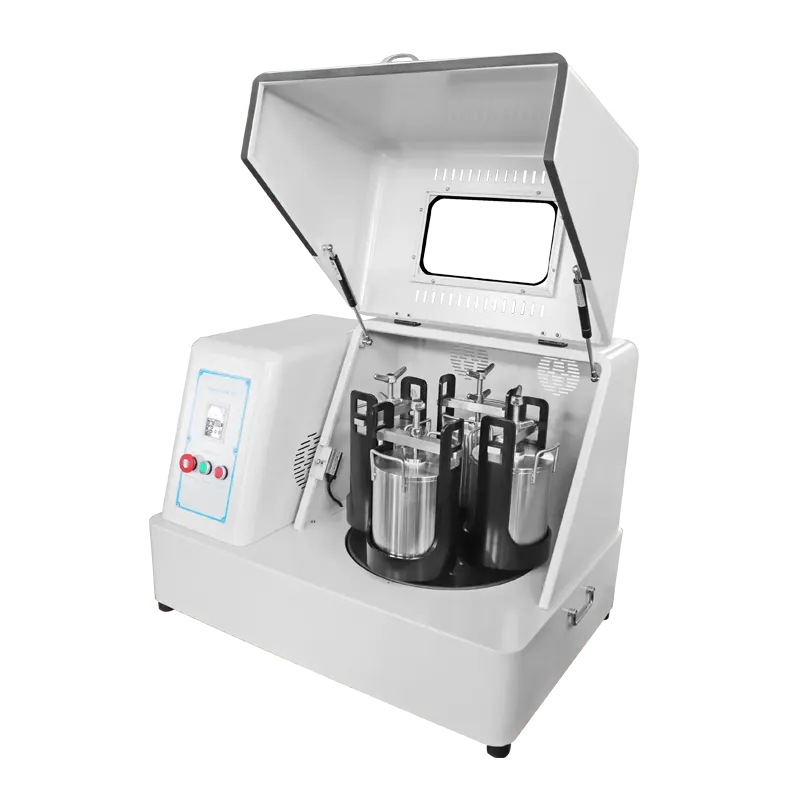
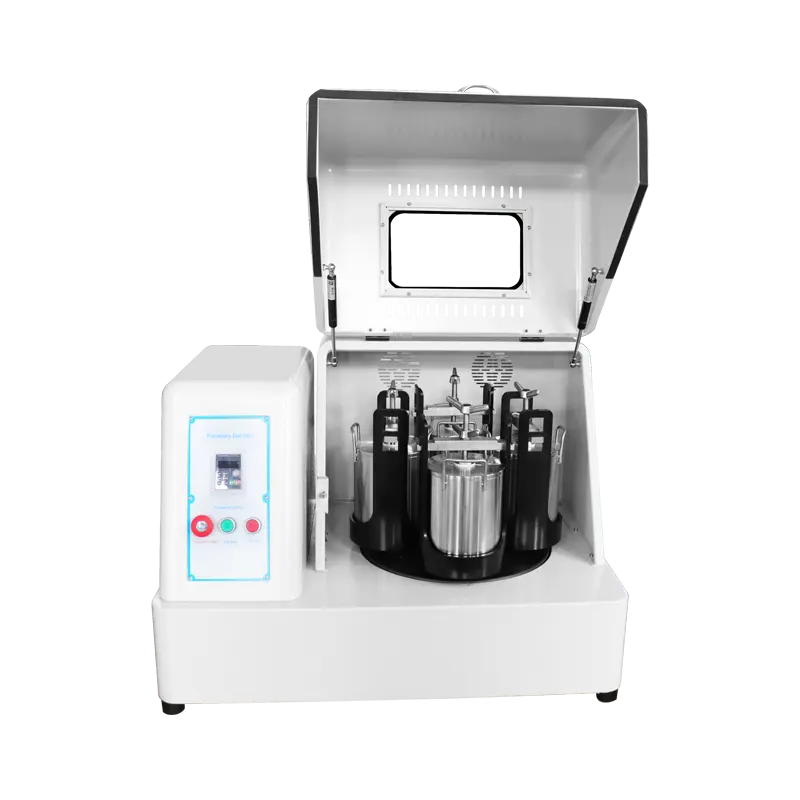
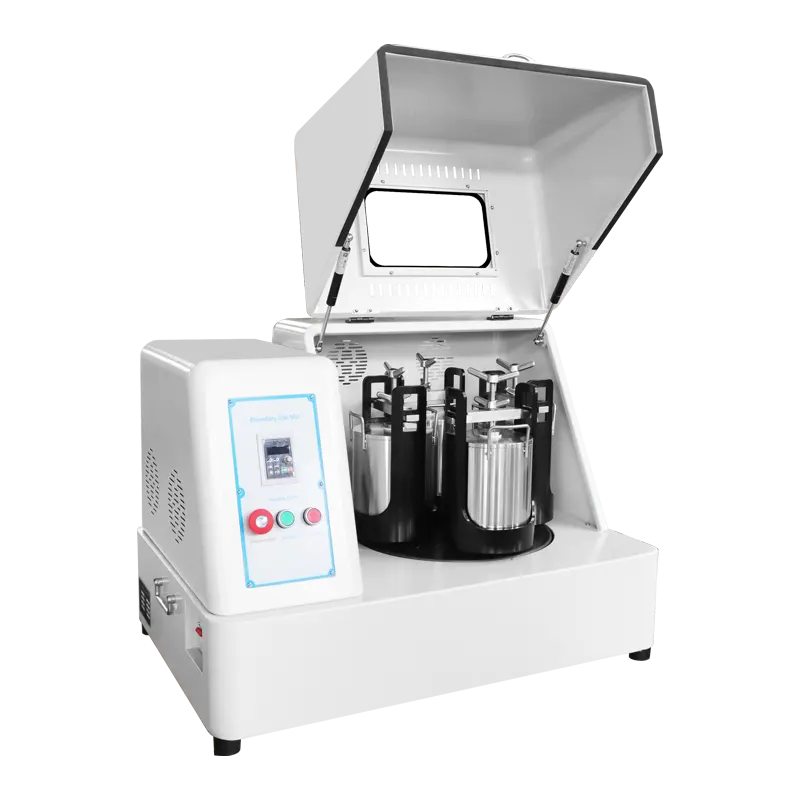
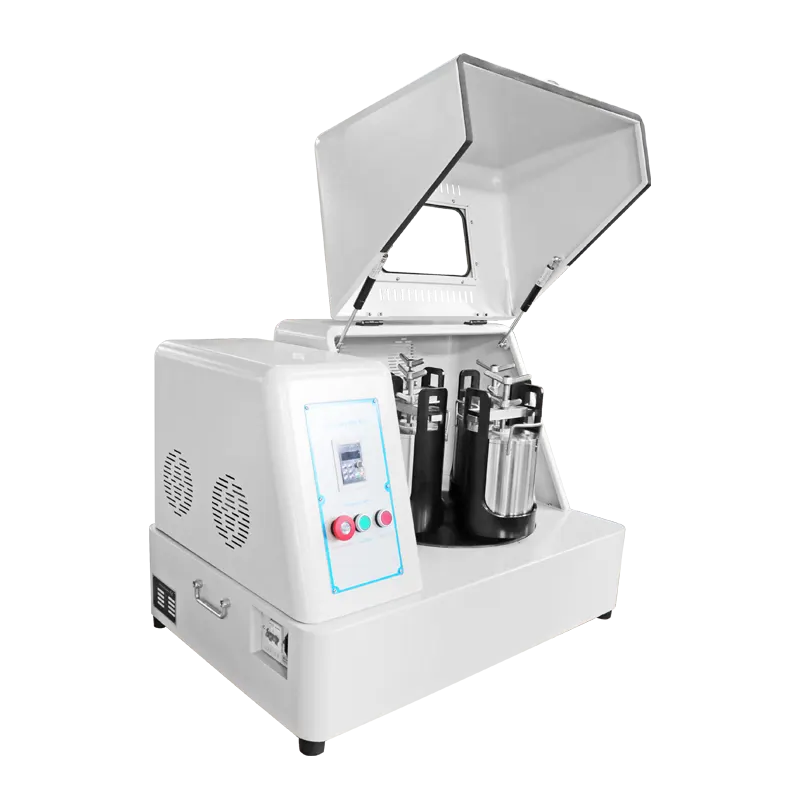
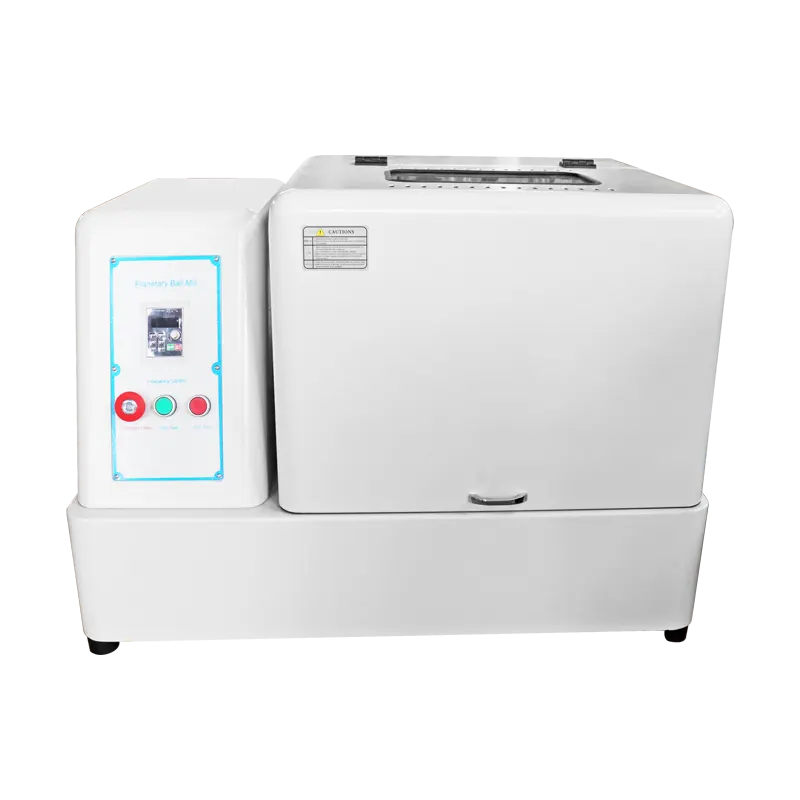
A vertical cabinet-style planetary mill for mixing, fine grinding and research sample preparation. The published XQM chart spans laboratory and larger configurations, so the model should be selected from the detailed table rather than from a shortened series label.
How it works
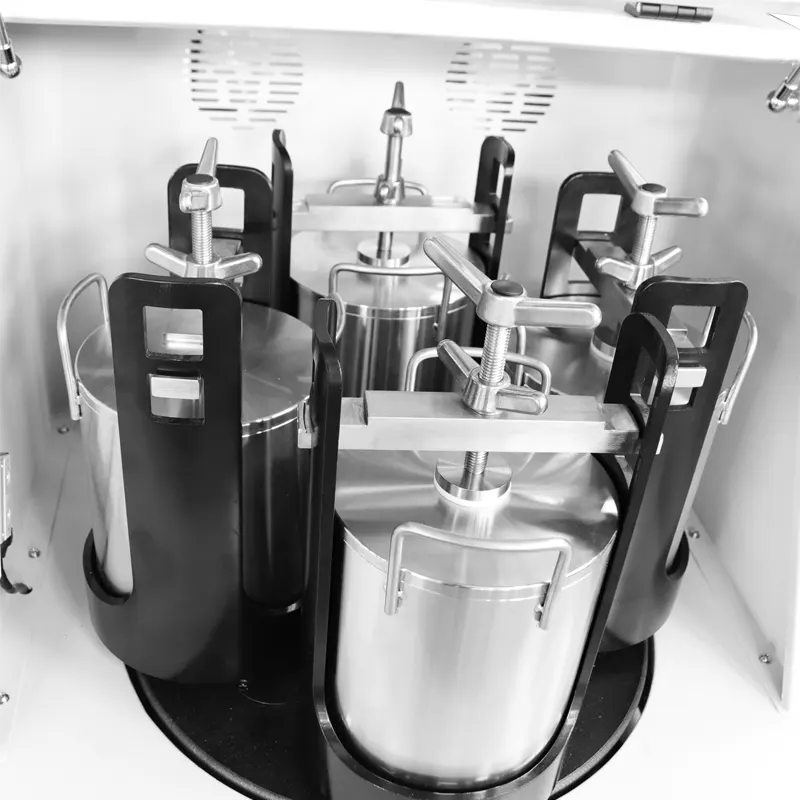
Four jars rotate on a revolving planetary disc. The combined motion drives impact and friction inside each jar. Processing can be organized as dry milling, wet milling or an appropriately specified sealed-jar process.
Key features
Four jar positions, with compatible standard and vacuum-jar volumes listed by model.
Separate tables identify capacity, physical dimensions, drive power and speed ranges.
Larger models have different power, supply and control arrangements; they are not simply higher-volume laboratory units.
Specifications
Published catalog references are reproduced below. Nominal volume is not a sample-mass rating. Confirm the selected model, material grade, electrical supply and complete supplied configuration in the quotation.
Model specifications — 1
Model
Nominal capacity
Configuration class
Compatible jar volume
Jar positions
Compatible vacuum jar volume
XQM-0.4
0.4L
Laboratory
25-100mL
4
50mL vacuum jar
XQM-1
1L
Laboratory
50-500mL
4
50-250mL vacuum jar
XQM-2
2L
Laboratory
50-500mL
4
50-250mL vacuum jar
XQM-4
4L
Laboratory
250-1000mL
4
50-500mL vacuum jar
XQM-6
6L
Laboratory
1-1.5L
4
50-1000mL vacuum jar
XQM-8
8L
Laboratory
1-2L
4
1-1.5L vacuum jar
XQM-10
10L
Laboratory
1-2.5L
4
1-2L vacuum jar
XQM-12
12L
Laboratory
1-3L
4
1-2L vacuum jar
XQM-16
16L
Laboratory
2-4L
4
1-3L vacuum jar
XQM-20
20L
Production
2-5L
4
2-4L vacuum jar
XQM-40
40L
Production
5-10L
4
5L vacuum jar
XQM-60
60L
Production
10-15L
4
10L vacuum jar
XQM-80
80L
Production
15-20L
4
15L vacuum jar
XQM-100
100L
Production
20-25L
4
20L vacuum jar
XQM-200
200L
Production
50L
4
25L vacuum jar
Model specifications — 2
Model
Machine mass (kg)
Dimensions (mm)
XQM-0.4
35
550x300x360
XQM-1
100
760×470×580
XQM-2
100
760×470×580
XQM-4
100
760×470×580
XQM-6
100
760×470×580
XQM-8
168
900×600×640
XQM-10
168
900×600×640
XQM-12
168
900×600×640
XQM-16
203
950×600×710
XQM-20
392
1200×790×930
XQM-40
656
1400×880×1070
XQM-60
950
1600×1070×1250
XQM-80
1300
1750×1140×1330
XQM-100
1300
1800×1150×1140
XQM-200
2725
2670×1600×2804
Model specifications — 3
Model
Electrical supply
Supply phase
Motor power (kW)
Speed control
Programmable run time (min)
XQM-0.4
220V 50Hz
Single phase
0.25kW
Variable-frequency control
1-9999
XQM-1
220V 50Hz
Single phase
0.75kW
Variable-frequency control
1-9999
XQM-2
220V 50Hz
Single phase
0.75kW
Variable-frequency control
1-9999
XQM-4
220V 50Hz
Single phase
0.75kW
Variable-frequency control
1-9999
XQM-6
220V 50Hz
Single phase
0.75kW
Variable-frequency control
1-9999
XQM-8
220V 50Hz
Single phase
1.5kW
Variable-frequency control
1-9999
XQM-10
220V 50Hz
Single phase
1.5kW
Variable-frequency control
1-9999
XQM-12
220V 50Hz
Single phase
1.5kW
Variable-frequency control
1-9999
XQM-16
380V 50Hz
Three phase
3kW
Variable-frequency control
1-9999
XQM-20
380V 50Hz
Three phase
4kW
Touchscreen
1-9999
XQM-40
380V 50Hz
Three phase
5.5kW
Touchscreen
1-9999
XQM-60
380V 50Hz
Three phase
7.5kW
Touchscreen
1-9999
XQM-80
380V 50Hz
Three phase
11kW
Touchscreen
1-9999
XQM-100
380V 50Hz
Three phase
11kW
Touchscreen
1-9999
XQM-200
380V 50Hz
Three phase
22kW
Touchscreen
1-9999
Model specifications — 4
Model
Reversing interval (min)
Planetary disc speed (rpm)
Jar rotation speed (rpm)
Revolution : rotation ratio
Published noise level (dB)
XQM-0.4
1-999
0-435
0-870
1:2
58±5
XQM-1
1-999
0-405
0-810
1:2
60±5
XQM-2
1-999
0-405
0-810
1:2
60±5
XQM-4
1-999
0-405
0-810
1:2
60±5
XQM-6
1-999
0-335
0-670
1:2
60±5
XQM-8
1-999
0-290
0-580
1:2
60±5
XQM-10
1-999
0-290
0-580
1:2
60±5
XQM-12
1-999
0-290
0-580
1:2
60±5
XQM-16
1-999
0-255
0-510
1:2
65±5
XQM-20
1-999
0-215
0-430
1:2
65±5
XQM-40
1-999
0-195
0-390
1:2
68±5
XQM-60
1-999
0-174
0-260
1:1.5
68±5
XQM-80
1-999
0-161
0-242
1:1.5
68±5
XQM-100
1-999
0-161
0-242
1:1.5
68±5
XQM-200
1-999
0-143
0-215
1:1.5
68±5
Applications
Research samples, ceramic and battery-material development, mineral powders and small-batch process studies.
Suitability depends on the actual sample, process and analytical requirements; a listed application is not a guaranteed final-particle-size result.
Accessories and options
Select jar and media materials, a compatible vacuum closure and the control interface. Ask about air cooling, liquid-nitrogen cooling or other assistance as a configured system, with utilities and temperature measurement agreed in advance.
Jar and media: confirm material, volume, holder fit and the complete working load.
Vacuum or gas requirements: specify the complete jar, lid and seal arrangement; no pressure rating is assumed.
Utilities and supply scope: state voltage, frequency, phase, destination and required documents; confirm included versus optional items.
Use the published model rows to check jar size and machine dimensions. Where production batches are intended, also compare the dedicated production-scale XQM range.
This is an XQM-family record, not verification of every XQM model. The requested 1 µm target was not demonstrated. Exact ceramic/media grades and measurement/dispersion methods are not supplied.
Equipment-family reference
Ore samples
XQM; exact model not recorded · Two agate-jar sample runs
Sample: 40.2 g and 102 g
Jar: 250 mL agate jar; agate media
Recorded sampling / duration: 90 min per sample
Recorded observations
Sample
Sample mass
D50 (µm)
D90 (µm)
Sample 1
40.2 g
2.82
9.03
Sample 2
102 g
3.62
11.23
Both samples were recorded in one entry, but identical composition/batch and all other conditions are not established. The difference cannot be attributed solely to sample loading. The 3 h total covers two 90 min runs.
How to plan a fair comparison
For a scale or jar-size comparison, retain the same material batch and analytical method and record the actual sample and media loads. Nominal mill capacities alone do not establish equivalent process conditions.
These anonymous records are not operating instructions. Measurement and dispersion methods are not fully specified in the test summaries; results apply to the reported samples and conditions.
How do laboratory and larger production XQM models differ?
Check each model’s jar capacity, drive power, supply, controls, dimensions and permitted load. Larger models need a separate process and installation assessment. Compare the dedicated production range when planning larger batches; nominal volume alone does not establish scale-up performance.
How should I select the XQM series configuration?
Use the published model rows to check jar size and machine dimensions. Where production batches are intended, also compare the dedicated production-scale XQM range. Four jar positions, with compatible standard and vacuum-jar volumes listed by model. Nominal mill capacity is not the usable sample mass; account for media and working space.
Which jars and grinding media should I request for this mill?
The XQM table separates standard jar and vacuum-jar volumes by model; a larger lid may change the permitted fit. Choose the jar working material and media around sample chemistry and contamination limits; confirm the complete loaded mass.
Are cooling and ultrasonic equipment included?
Select jar and media materials, a compatible vacuum closure and the control interface. Ask about air cooling, liquid-nitrogen cooling or other assistance as a configured system, with utilities and temperature measurement agreed in advance. Optional equipment is included only when it is explicitly listed in the agreed configuration and quotation.
What trial evidence is available for this mill?
Silica: XQM; exact model not recorded, 176 g in 500 mL alumina/corundum jar, 45 min. This is an XQM-family record, not verification of every XQM model. The requested 1 µm target was not demonstrated. Exact ceramic/media grades and measurement/dispersion methods are not supplied. A free sample-grinding application can be reviewed by TENCAN engineers.
What should I include in an export quotation request?
Specify XQM series, sample and jar requirements, destination, mains voltage, frequency and phase. Use the published model rows to check jar size and machine dimensions. Where production batches are intended, also compare the dedicated production-scale XQM range. Confirm included accessories, packing, required documents, commercial terms and lead time in the quotation.
Start with your sample.
Nominal capacity, jar volume and usable sample load are different. Confirm the model, jars and electrical requirements with our engineers.